
Going Green: Understanding Vegan Skincare And Its Benefits
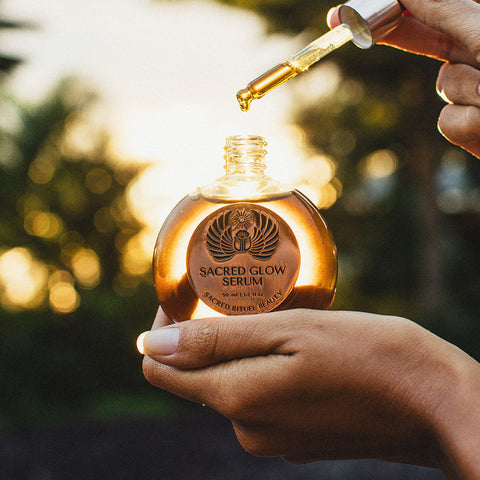
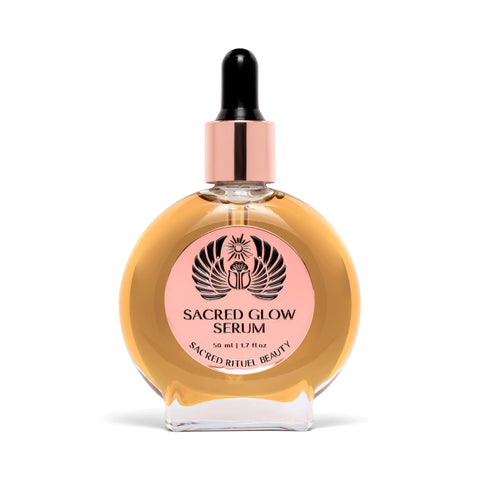
The benefits of vegan skincare are real, and they are not just ethical: a truly vegan, plant-based routine means no animal-derived ingredients, no animal testing, and a formula built entirely from botanicals your skin actually recognizes. Plant oils are documented to support and repair the skin's moisture barrier, and because they are compatible with the skin's own lipids, they sink in to nourish rather than sitting on top (Lin et al. 2018). At Sacred Rituel, every product is formulated by folk herbalist Marysia Miernowska, founder of the School of the Sacred Wild, from cold-pressed, whole-plant, certified-organic botanicals and nothing animal-derived. Our face hero, Sacred Serum, is a cold-pressed phytocomplex of fourteen organic botanical oils, and people in our community consistently tell us it leaves their skin softer, calmer, and more radiant. A quick note of good practice: patch test any new oil on your inner arm first.
Key Takeaways:
- Vegan skincare means plant-based and cruelty-free: No animal-derived ingredients, no animal testing. The best vegan formulas are also certified organic and free of synthetic fragrance, parabens, and other irritants you want to skip.
- Whole-plant botanicals work with your skin: Plant oils are documented to support and repair the moisture barrier and are compatible with the skin's own lipids, so they nourish from within rather than sitting on top (Lin et al. 2018).
- Whole-plant and cold-pressed beats isolated and synthetic: The full phytocomplex of a plant does more than any isolated molecule (Russo 2019), and cold-pressing preserves the delicate vitamins and antioxidants that heat and solvents destroy.
Vegan skincare has moved from niche to mainstream, and for good reason. Once you understand what is actually in the bottle, the case for plant-based skincare becomes hard to argue with: it is kinder to animals, gentler on the planet, and, when it is built from whole, cold-pressed botanicals, genuinely better for your skin. The honest, confident answer to "is vegan skincare worth it?" is yes, and the plant world has been doing this work far longer than any lab.
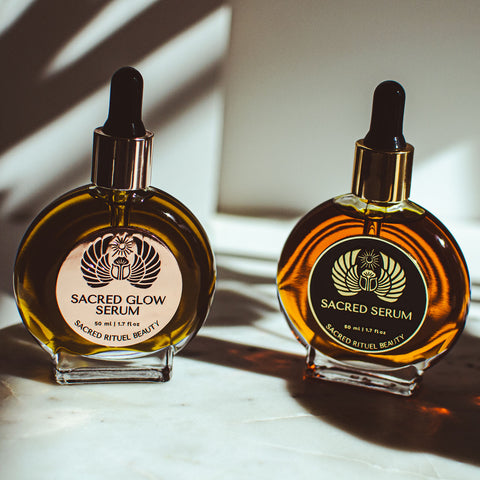
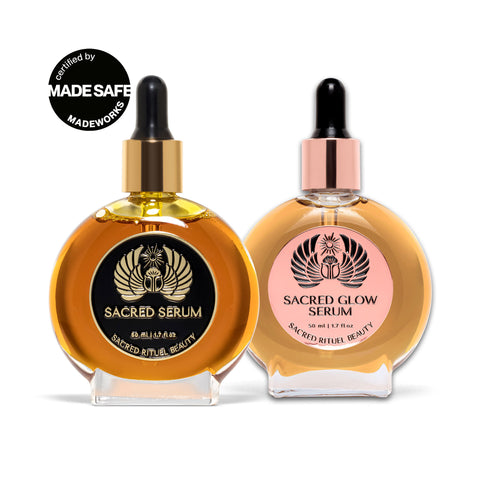
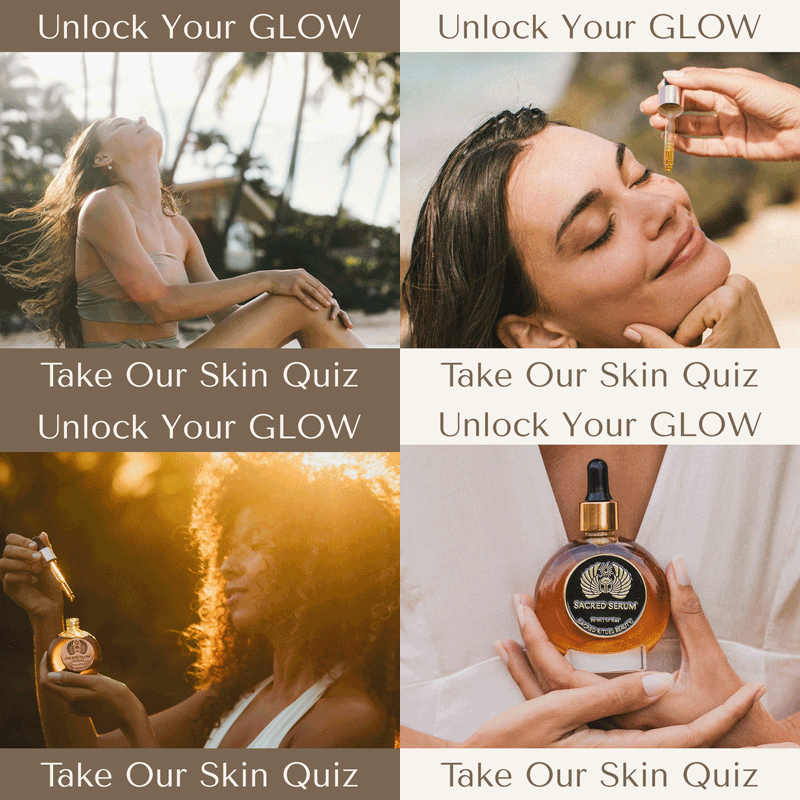
At Sacred Rituel, vegan is not a marketing badge added on at the end. Every product is formulated by folk herbalist Marysia Miernowska, founder of the School of the Sacred Wild, from cold-pressed, certified-organic, whole-plant botanicals chosen for what plants actually do for skin, with nothing animal-derived and nothing tested on animals. Our face hero is Sacred Serum, a cold-pressed phytocomplex of fourteen organic botanical oils.
In this guide we will define what vegan skincare really is, make the case for whole-plant, plant-based formulas, compare vegan to conventional skincare honestly, show you how to identify a genuinely vegan product, and flag the ingredients worth avoiding so your routine is as clean as it is kind.
What Is Vegan Skincare?
Vegan skincare is any product made entirely from plant-based and mineral ingredients, with no animal-derived components such as lanolin, beeswax, carmine, or collagen, and no animal testing anywhere in its making. It is a way of taking full control of what goes on your skin: choosing botanicals over byproducts, and transparency over guesswork.
Vegan and cruelty-free are related but not identical. Vegan means no animal-derived ingredients. Cruelty-free means no animal testing. The cleanest brands are both, and the very best go further still, choosing certified-organic botanicals and leaving out synthetic fragrance and harsh preservatives entirely. Sacred Rituel is vegan, cruelty-free, and MADE SAFE certified, which means every ingredient is screened against a list of known harmful substances.
Is vegan skincare Halal?
Vegan skincare is generally considered Halal-friendly, because it contains no animal-derived ingredients and no alcohol-based animal byproducts. That said, the only way to be certain is to read the full ingredient list, since "vegan" and "Halal" are certified by different bodies. A genuinely transparent brand makes its complete ingredient list easy to find, which is the standard you should hold any product to.
This is also a good moment to make the larger case. The reason to choose vegan skincare is not only what it leaves out, but what it puts in. When a formula is built from whole plants rather than animal byproducts and synthetic fillers, your skin receives the fatty acids, antioxidants, and plant compounds it actually recognizes.
Plant-Based Ingredients Your Skin Recognizes
Plants are dense sources of the fatty acids, vitamins, and antioxidants healthy skin depends on. Whole-plant oils like Jojoba Oil, Rosehip Oil, almond, and sea buckthorn deliver these nutrients in a form the skin can use. Jojoba is especially remarkable: its wax esters closely mirror the skin's own sebum, which is why it suits nearly every skin type. Rosehip is a natural source of vitamin C and carotenoids associated with the look of firmer, more even-toned skin. There is no animal byproduct that does this work better than the plants themselves.
Cruelty-Free By Definition
Choosing vegan skincare means no animal was tested on or harmed for your routine. Many conventional cosmetics are still tested on animals, a practice that is as unnecessary as it is unkind given how well plant-based formulas perform. A vegan, cruelty-free product lets you care for your skin with a clear conscience.
Cleaner, Non-Toxic Formulas
Pure botanical ingredients make it far easier to keep a formula non-toxic. The best vegan skincare skips synthetic fragrance, parabens, sulfates, and phthalates, ingredients that can irritate skin and that many people prefer to avoid entirely. A fragrance-free, plant-based formula gives your skin nourishment without the additives. At Sacred Rituel, the aroma you breathe in comes only from the botanicals themselves, never from synthetic fragrance.
Kinder To The Planet
Plant-based ingredients are generally more sustainable and more biodegradable than animal-derived ones, and they support farming that can be kinder to the land. Choosing certified-organic botanicals goes one step further, keeping synthetic pesticides off your skin and out of the soil. Caring for your skin and caring for the earth can be the same act.
Why Whole-Plant, Cold-Pressed Vegan Skincare Is Better
Not all vegan skincare is created equal. A product can be technically vegan and still be built on cheap, heavily processed, or synthetic-heavy ingredients. What separates truly nourishing plant-based skincare from the rest is whether the botanicals are whole and how they were extracted.
The Whole Plant Outperforms The Isolated Molecule
Herbalists have long understood that the whole plant working in concert does more than any single isolated part, and the science increasingly agrees. The full phytocomplex of a botanical, its many fatty acids, polyphenols, carotenoids, and tocopherols, works together with an effect greater than any one molecule could deliver alone (Russo 2019). This is why a whole-plant oil nourishes more completely than a lab-isolated active, and why Sacred Serum is composed of fourteen botanicals in synergy rather than a single hero compound.
Natural Nutrients Are More Bioavailable
Natural is not just a feeling here, it is a chemistry. Vitamin C delivered in a whole-food botanical matrix arrives alongside the cofactors that help skin make use of it, rather than as a lone synthetic molecule (Carr and Maggini 2017). Natural vitamin E from plants is a full family of tocopherols and Tocotrienols Vitamin E, where the synthetic version is typically a single isolated form. Whole-plant skincare gives your skin the complete spectrum the plant evolved to provide.
Cold-Pressing Keeps The Actives Alive
How an oil is extracted matters as much as which plant it came from. Cold-pressing extracts oil without heat or solvents, which preserves the delicate tocopherols, polyphenols, and carotenoids that nourish skin and that high heat or chemical processing would destroy. Cold-pressed oils are unrefined and concentrated, which is exactly why we cold-press every oil in Sacred Serum. People in our community consistently tell us they can see and feel the difference a living, whole-plant oil makes.
Plant Oils Work With Your Skin's Barrier
Whole-plant oils are not just sitting on the surface. Plant oils are documented to support and repair the skin's moisture barrier, and because they share the structure of the skin's own lipids, they are compatible with its natural lipid matrix and absorb to condition the deeper layers of the outer skin (Lin et al. 2018). That is the mechanism behind what people describe to us as skin that feels calmer, more comfortable, and more resilient.

Vegan vs. Conventional Skincare: What Is The Difference?
Vegan and conventional skincare can look identical on the shelf, but they differ in three ways that matter for your skin and for the world.
- The ingredients: Vegan skincare is built on plant oils and botanical extracts that are gentle and nourishing. Conventional products may rely on animal byproducts, synthetic fragrance, and dyes that more often irritate than soothe.
- The ethics: Vegan, cruelty-free products are never tested on animals and contain nothing animal-derived. Conventional cosmetics may be either or both.
- The footprint: Plant-based ingredients are typically more sustainable and biodegradable, and the best vegan brands extend that care to recyclable, light-protective packaging.
If you want to go deeper on simplifying your shelf, our guide to the best minimalist skincare brands pairs naturally with the vegan philosophy: fewer, better, plant-based ingredients.
How To Identify Genuinely Vegan Skincare
With so many products claiming to be clean, here is how to tell a genuinely vegan, well-made product from a marketing claim:
- Read the full ingredient list: Look for the obvious animal-derived ingredients (lanolin, beeswax, carmine, collagen, silk) and choose plant-based botanicals instead. A brand that hides its full list is a brand to skip.
- Look for cruelty-free verification: Labels like "not tested on animals" and the Leaping Bunny logo signal a verified cruelty-free product.
- Favor certified organic and MADE SAFE: These certifications mean the botanicals are grown clean and screened against known harmful ingredients.
- Check how the oils are made: Cold-pressed, unrefined plant oils retain the actives that heavily processed oils lose.
For the face, that points toward a cold-pressed, whole-plant facial oil. Sacred Serum meets every one of these marks: vegan, cruelty-free, MADE SAFE certified, certified-organic, and cold-pressed.
Skincare Ingredients To Avoid
Choosing vegan is a powerful start, but a product can be vegan and still carry synthetic ingredients worth avoiding. Whether you are reading a vegan label or any other, watch for these:
- Synthetic fragrance: A common cause of irritation and a known concern for hormone disruption. Choose fragrance-free formulas, or ones scented only by the plants themselves.
- Parabens: Preservatives that can disrupt the endocrine system and irritate skin.
- Phthalates: Plasticizing chemicals linked to hormone disruption.
- Sulfates: Harsh detergents that strip the skin's natural oils and can leave it dry and irritated.
Many of these also show up as comedogenic, pore-clogging additives. Our guide to pore clogging ingredients to avoid in skincare goes through the full list. The cleaner alternative is simple: whole, plant-based botanicals like aloe, jojoba, and rosehip that nourish rather than irritate.
Making The Switch To Vegan Skincare
Transitioning to a vegan routine is easier than it looks, and you do not have to do it all at once.
- Start with one step: Swap a single product for a vegan alternative and build from there. A whole-plant facial oil is a beautiful first step.
- Read labels and certifications: Look for "vegan," "cruelty-free," "certified organic," and MADE SAFE, and read the full ingredient list rather than the front-of-bottle claim.
- Build a simple ritual: A pared-back routine of a few well-made plant-based products usually serves skin better than a crowded shelf. The Sacred routine set brings Sacred Serum together with a rose mist and a body oil so your whole ritual is vegan and whole-plant from face to body.
- Be patient and consistent: Skin responds to consistency. Give a new plant-based routine a few weeks, and patch test each new oil on your inner arm first.
Want to make your own plant-based treat at home while you transition? Our DIY face masks for soft, glowing skin are an easy, vegan place to begin. And if you are curious about a single ingredient that bridges oily and dry skin, see how jojoba oil works for both acne-prone and dry skin.
Final Thoughts
The benefits of vegan skincare are not a trend, they are a return to what skin has always thrived on: whole, plant-based nourishment, free of animal byproducts and the synthetic additives worth avoiding. When that vegan formula is also cold-pressed, certified-organic, and built from the whole plant, it does not just spare animals and the planet, it genuinely feeds your skin the fatty acids, antioxidants, and plant compounds it recognizes.
That is the standard Marysia formulates Sacred Rituel to, and it is why people in our community keep telling us their skin looks calmer, softer, and more radiant on whole-plant oils. If you want skincare that is kind to animals, gentle on the earth, and deeply nourishing to your skin, a vegan, whole-plant ritual is one of the most rewarding choices you can make.
Sources:
- Urban, K., Giesey, R., & Delost, G. (2022). A Guide to Informed Skincare: The Meaning of Clean, Natural, Organic, Vegan, and Cruelty-Free. Journal of Drugs in Dermatology, 21(9), 1012-1013.
- Lin, T.-K., Zhong, L., & Santiago, J. (2018). Anti-Inflammatory and Skin Barrier Repair Effects of Topical Application of Some Plant Oils. International Journal of Molecular Sciences, 19(1), 70. https://doi.org/10.3390/ijms19010070
- Russo, E. B. (2019). The Case for the Entourage Effect and Conventional Breeding of Clinical Cannabis: No "Strain," No Gain. Frontiers in Plant Science, 9, 1969. https://doi.org/10.3389/fpls.2018.01969
- Carr, A. C., & Maggini, S. (2017). Vitamin C and Immune Function. Nutrients, 9(11), 1211. https://doi.org/10.3390/nu9111211
Keep exploring: pore clogging ingredients to avoid, jojoba oil for acne and dry skin, the best minimalist skincare brands.
Frequently Asked Questions
Is vegan skincare Halal?
Vegan skincare is generally considered Halal-friendly, because it contains no animal-derived ingredients. The only way to be certain is to read the full ingredient list, since "vegan" and "Halal" are certified by different bodies. A transparent brand makes its complete ingredient list easy to find, which is the standard to hold any product to.
Why do vegans’ skin glow?
A whole-food, plant-rich lifestyle floods the body with antioxidants, vitamins, and minerals, which many people feel shows up as a healthy, radiant complexion. The same logic applies on the outside: when your skincare is plant-based and whole-plant rather than animal-derived and synthetic, your skin receives the fatty acids and antioxidants it recognizes. People in our community consistently tell us their skin looks more radiant on whole-plant oils like Sacred Serum.
What does 100% vegan mean?
"100% vegan" means a product is completely free of any animal-derived ingredients, such as lanolin, beeswax, carmine, collagen, or silk. It is worth checking that the brand is also cruelty-free, meaning no animal testing, since the two are separate claims. As always, read the full ingredient list to confirm there are no hidden animal byproducts.
Why do people buy vegan cosmetics?
People choose vegan cosmetics for three main reasons: ethics (no animal-derived ingredients and no animal testing), skin (plant-based, often gentler formulas free of synthetic fragrance and harsh additives), and the planet (more sustainable, biodegradable ingredients). The best vegan products deliver on all three at once, especially when they are also certified organic and whole-plant.
What are the hidden benefits of vegan skincare?
Beyond the obvious ethical and environmental wins, the hidden benefit of vegan skincare is the quality of the ingredients themselves. Whole, plant-based botanicals are rich in fatty acids, antioxidants, and the full spectrum of plant compounds your skin recognizes, and natural nutrients in a whole-food matrix tend to be more bioavailable than isolated synthetics (Carr and Maggini 2017). When those botanicals are also cold-pressed, the delicate vitamins and antioxidants stay intact, so your skin gets living, whole-plant nourishment.
Why do vegans have the best skin?
A plant-rich diet and a plant-based routine both feed skin the antioxidants, vitamins, and healthy fats it thrives on, without the synthetic additives and animal byproducts that can weigh conventional products down. The case is strongest for whole-plant skincare: plant oils are documented to support the skin's moisture barrier and are compatible with the skin's own lipids (Lin et al. 2018). It is less about a label and more about giving skin the whole-plant nourishment it recognizes.
Radiance Is Personal. Let’s Reveal Yours...
All Day Glow Essentials