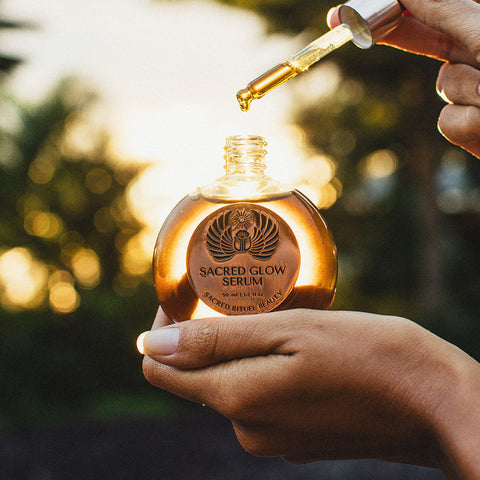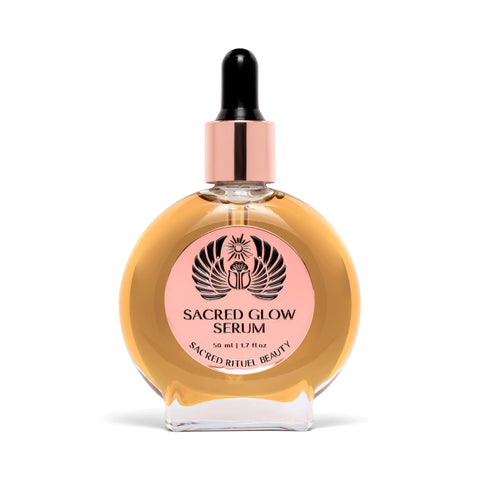
For Reactive Skin
Why 'Clean' Skincare Keeps Flaring Sensitive Skin in Perimenopause (and the One-Step Ritual People Are Switching To)
6 min read

This serum is incredible. It helps the redness and sensitivity I developed in perimenopause.
You stand in the bathroom on a Tuesday morning, lean into the mirror, and the cheek you cleansed last night is blotchy again. The angry patch around your nose is back. The product that did it was supposed to be the gentle one.
You did the work. You switched to clean, then organic, then pH-balanced.
You read the labels. You paid the premium. Your face reacted anyway.
If this is the loop you have been in, here is the part nobody tells you. The brand was not the problem. The shelf was not the problem. The architecture underneath the shelf is the problem.
Most of what the clean-skincare aisle now sells you for sensitive skin is built around the same idea as the conventional aisle: one isolated active, dialed up, applied daily, expected to behave. Cleaner inputs. Same logic. Same demand on your face.
This piece is about a different architecture. A cold-pressed botanical face oil formulated by an herbalist who has spent two decades working with whole plants, not isolates. Five steeped flowers, fourteen organic oils. The reason it keeps coming up in verified reviews from people experiencing perimenopause whose skin reacts to almost everything else is not that it is gentler than the last clean serum. It is that the question it answers is different.
What is actually happening to perimenopausal skin
The shift is hormonal, and it is real. Estrogen begins to fall in the early 40s for most people and continues to drop through menopause. Skin notices first.
Estrogen drops, sebum drops, and the barrier gets quietly thinner
Sebum production tapers. The lipid film that quietly absorbed every product you ever tried for decades gets thinner. The moisture barrier thins. Ingredients that used to sit politely on the surface now reach deeper, faster.
The same niacinamide, the same retinol, the same fragrance you wore for fifteen years can suddenly read as a threat to a barrier that no longer has the lipid headroom it used to. This is what one verified review at 37, navigating perimenopause, named with painful precision: I went from needing nothing to needing everything, in what feels like overnight.
Her current skin, in her words: very reactive, highly sensitive, contact dermatitis with almost every product that I try, to include organic and pH balanced.
This is biology, not fragility
Nothing about this means your skin is broken. It means your skin has changed jobs.
The architecture that supported you at 32 does not match the barrier you have at 47 or 54. Meet the skin where it is. What sensitive, perimenopausal skin needs first is lipid replenishment, and what it needs to stop getting is one more isolated active asking it to perform.
Why most products do not work for sensitive, reactive skin (even the clean ones)
The clean-beauty movement did real good. It pulled the worst inputs out of the supply chain: parabens, phthalates, sulfates, synthetic fragrance. The underlying logic stayed. The category still goes: pick one isolated active per problem, dial up the concentration, layer the actives into a routine, expect the face to comply.
Isolates can be technically tolerated and still flare a thinning barrier
An isolate is what happens when you take a single compound out of a plant and present it on its own. Centella asiatica, lifted out of its full leaf chemistry. Niacinamide, divorced from the B-complex it lives inside. Bisabolol, separated from the chamomile flower it grew in.
The isolate is bioavailable and predictable. It is also, biochemically, an active your face has to negotiate with: a single foreign signal arriving on the barrier without the cofactors that would have softened its landing. For most people in their 20s and 30s with intact barriers, this is fine. For someone in perimenopause with a thinner barrier and a more reactive landscape, the same isolate she tolerated at 35 can now flare her cheek for a week.
The clean shelf rebuilt the ingredients and kept the architecture
What customers actually report is the architecture problem, not an ingredient problem. Contact dermatitis on organic products. Perioral dermatitis from the one retinol she tried. Cheeks that flush on the new clean serum, the way they used to flush on the old one.
The shelf changed; the demand on her face did not. The next bottle she picks up still expects her barrier to negotiate with another isolated compound.
What the herbalist tradition does instead
Herbalists have steeped flowers into oils for centuries. The reason is not nostalgia. The reason is that the flower and the oil hold each other together.
Whole-plant infusion preserves the cofactors that softened the original landing
When you take a fresh chamomile flower and submerge it in a cold-pressed oil for weeks, the oil pulls out what is in the flower: bisabolol, but also the apigenin, the chamazulene, the flavonoids, the polyphenols, the trace minerals, the lipid-soluble fragments of every cofactor the plant produced together. Nothing arrives alone. The chamomile that lands on your skin is the chamomile your grandmother's mother would have recognized, carried in a lipid that resembles the lipid film your barrier secretes.
Modern science calls this the phytocomplex, or the entourage effect: the documented finding that the therapeutic profile of a whole plant comes from the synergistic interplay of all its compounds, not from any one molecule isolated and amplified [2]. The same logic shows up in vitamin science. Vitamin C delivered in its natural matrix, complete with the bioflavonoids the plant produced alongside it, is more bioavailable than synthetic L-ascorbic acid on its own [5]. Skin recognizes the original signal.
Cold-pressed oils are lipid-compatible with the barrier they are landing on
The second piece is the base. A peer-reviewed review in the International Journal of Molecular Sciences confirms what herbalists already worked from observation: certain plant oils, including sunflower, jojoba, and the cold-pressed lipid family Sacred Serum is built on, are highly compatible with the skin's own lipid matrix, supporting barrier function and acting as effective vehicles for the compounds carried in them [1]. The oil is part of the medicine.
The five flowers carry centuries of soothing tradition
Calendula has been steeped into skin oils for centuries; the modern pharmacology literature attributes its calming effect to the flavonoids and triterpenoids in the flower [3]. Chamomile sits in the same tradition, carrying bisabolol and apigenin together rather than apart. Comfrey, helichrysum, and lavender each bring their own steeped profiles: aromatic compounds, polyphenols, traditional skin-comforting cofactors. Rosa damascena, the rose used in the formula, is documented in peer-reviewed pharmacology reviews as broadly skin-comforting and antioxidant-supporting [4].
None of this is novel science. It is the oldest skincare framework on earth, applied with modern formulation rigor and modern certification.
Why Sacred Rituel is different
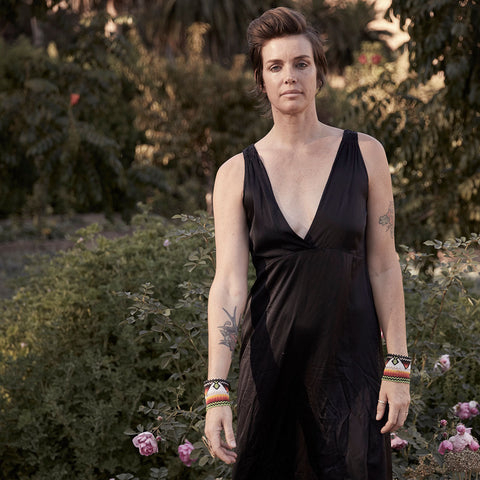
Sacred Serum was formulated by Marysia Miernowska, an herbalist, author, and the founder of the School of the Sacred Wild. Her work is rooted in the Wise Woman Tradition of Healing and shaped by Polish folk herbalism, with two decades of formal study across Western, Ayurvedic, and Traditional Chinese herbal medicine. Sacred Rituel is the brand she built to translate that lineage into a daily ritual people could actually keep.
The formulation reflects the philosophy, not a trend cycle
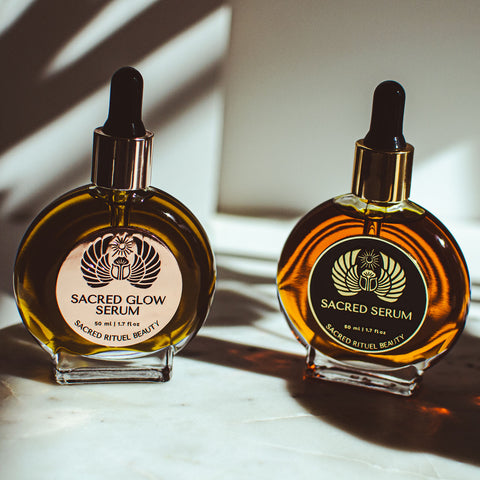
Sacred Serum is a cold-pressed, whole-plant botanical face oil. The structure: 14 cold-pressed organic oils, 8 herbal infusions, 4 essential oils, and 2 specialty extracts. The phytocomplex is intentional.
Pomegranate seed oil, amla, and rosehip carry research-documented antioxidant and collagen-pathway support for skin that is changing. Sea buckthorn carries the carotenoid family. Jojoba is a wax ester, structurally similar to the lipid film a healthy barrier secretes; it is the principal carrier the rest of the formula rides on.
The infusion of five soothing flowers is the part most clean serums skip
The five steeped flowers, chamomile, calendula, comfrey, helichrysum, and lavender, are infused at low heat into the oil base over weeks. This is the slow part of the formulation that you cannot fake with an isolate dropped in at the end. The infusion is why Sacred Serum reads as quiet on a barrier that is no longer tolerating clean isolates, while still delivering visible support.
Made in Los Angeles, batch-numbered, certified across three axes
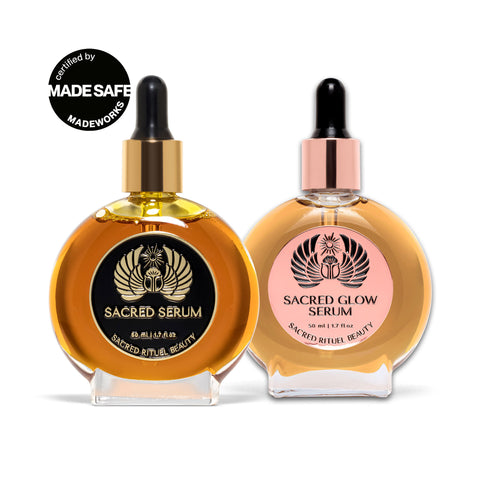
Sacred Rituel produces, bottles, and batch-numbers every product in its Los Angeles facility. USDA Organic. MADE SAFE. Leaping Bunny. The certifications are the floor, not the marketing.
The differentiator is the architecture underneath them.
What changes when you switch
The pattern in the verified-review corpus is consistent. Across the sensitivity-tagged Sacred Serum reviews, the most commonly described transformation, in customers' own words, is sensitivity that quieted down. Lasting moisture and a healthy glow follow close behind. Calmer-looking redness is named throughout.
What customers actually say
A 46-year-old practicing herbalist, after two days: I am 46 with sensitive skin and in just two days my skin is looking amazing. As someone who has studied herbalism and is a practitioner, I was searching for a good, ethical botanical face oil. I have now found it.
Someone navigating hypersensitive, easily flushed skin: I have hypersensitive skin that becomes flushed in the smallest about of sun. Since using it I can go on 2 mile walk and my skin not react at all.
A perimenopausal customer at 41: This serum is incredible. It helps the redness and sensitivity I developed in perimenopause. I have the full size and love using the roller on the go.
A long-time sensitive-skin customer, post-six-month use: My skin was dry red bumpy and full of age spots and now it is hydrated calm smooth and my age spots are starting to fading. My husband has even noticed.
What it costs to keep doing what you are doing
If you stay on the current path, the next clean serum you try has a meaningful chance of flaring you again. Not because the next brand is bad. The architecture is broken, not which brand you picked.
Another 30 days of the cheek that flushes. Another work meeting you spend aware of your face. Another month of management, instead of care.
The ritual, in three steps
This is the part Marysia designed to be small enough to keep.
1. Mist
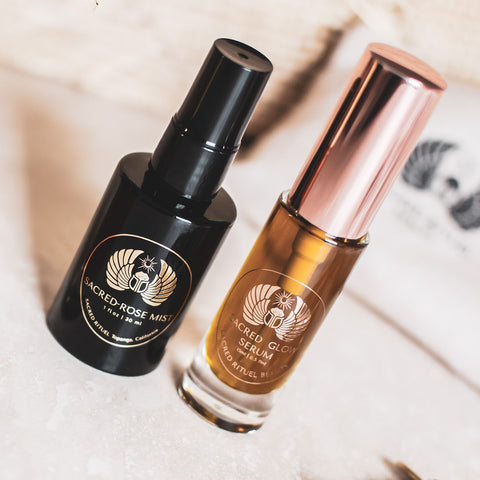
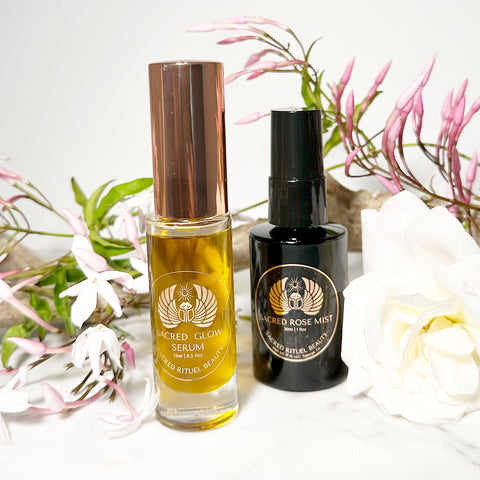
Spray Sacred Rose Mist onto clean skin, or simply skip to step two on slightly damp skin if you do not have the mist yet.
2. Press
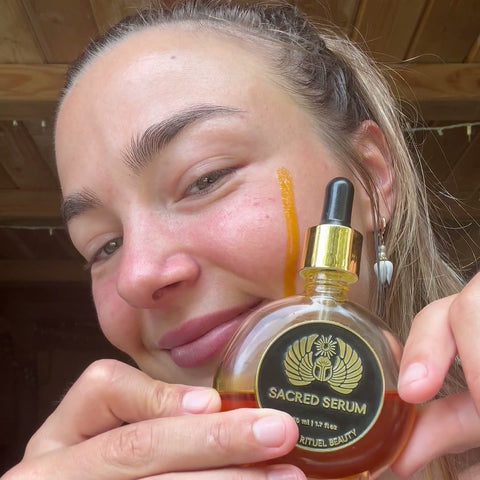
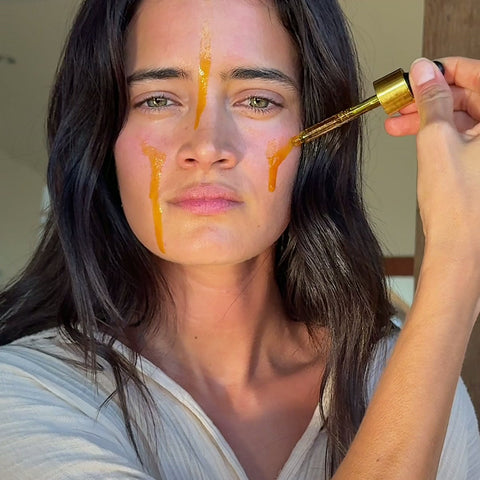
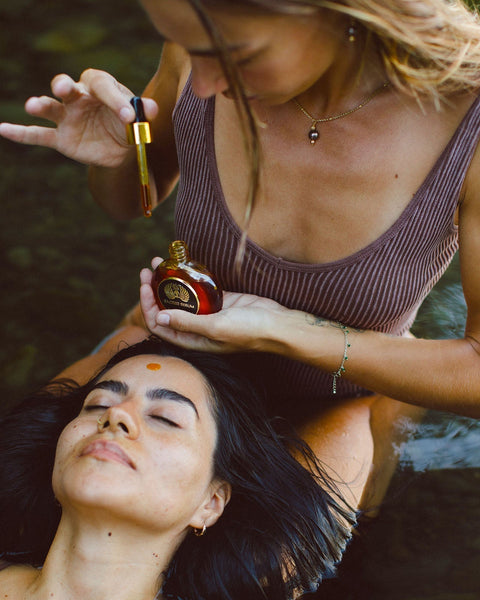
One pump of Sacred Serum, pressed into the cheeks first, then the forehead and jawline. Pressed, not rubbed. Warm palms help the oil absorb.
3. Let it land
Wait 30 seconds. No layering. No follow-up cream. One step replaces the routine that gave you the reaction in the first place.
If you have spent the last two years inside a flare-react-switch loop with sensitive perimenopausal skin, the question worth holding is not which brand is gentler. It is which architecture stops asking your face to defend itself in the first place.
Frequently Asked Questions
Is Sacred Serum safe for people with perimenopausal sensitivity or rosacea-prone skin?
Verified customer reviews from people with perimenopausal sensitivity, rosacea-prone cheeks, and reactive complexions describe Sacred Serum as gentle enough for skin that flared on other clean alternatives. One reviewer at 37, navigating perimenopause and contact dermatitis from almost every product she had tried, including organic and pH-balanced ones, reached for it after the rest had failed. Sacred Serum is a cosmetic face oil, not a treatment for diagnosed conditions like rosacea or perioral dermatitis. The honest framing: it is the one a meaningful number of perimenopausal, sensitive-skin customers describe as the product that finally let their face be quiet.
What makes Sacred Serum different from other clean or sensitive-skin serums?
Most clean serums for reactive skin are built around a single isolated cosmeceutical: niacinamide alone, centella isolate alone, bisabolol alone. Isolates can be technically tolerated and still feel like one more active a sensitive complexion has to negotiate with. Sacred Serum is the opposite architecture. Five whole flowers, chamomile, calendula, comfrey, helichrysum, and lavender, are steeped into a base of 14 cold-pressed organic oils. The plants come in whole, with their fatty acids, polyphenols, and aromatic compounds together. Nothing isolated. Nothing escalated.
Does Sacred Serum contain anything that commonly triggers sensitive skin?
Yes, and this is worth naming honestly. Sacred Serum contains four essential oils: rose, lavender, frankincense, and geranium. Most sensitive-skin customers tolerate the scent well, and many describe it as one of the reasons the daily ritual feels grounding. A small number of customers find the scent stronger than expected. One verified review reads: I love the way this oil feels on my skin but I am super sensitive to fragrances and it gives me a major headache every time I use it. If you have known sensitivity to essential oils, this is worth knowing before you order. The 30-day guarantee exists precisely for this kind of personal-fit question.
Can I use it during perimenopause and menopause, when my skin started reacting to everything?
The strongest customer voice in the sensitivity-tagged review pool comes from people experiencing perimenopause and menopause. Estrogen falls, sebum production drops, the moisture barrier thins, and skin that was untroubled for decades becomes reactive almost overnight. This is biology, not fragility. The whole-plant phytocomplex meets that biology with cold-pressed fatty acids and herbal infusions that skin recognizes as lipid-compatible, rather than another active to defend against. Customers describe redness and reactivity that quieted down, skin that finally felt calm, and a face that stopped being a daily event to manage.
Can I skip sunscreen if I am using Sacred Serum?
No. Sacred Serum is not a sunscreen. It is a cold-pressed botanical face oil, not registered as an over-the-counter sun-protection product, and it should be worn alongside dedicated sun protection on days you will be outdoors. The botanical antioxidants in the formula support skin that has been through normal daily light exposure; they are not a substitute for SPF.
References
- Lin, T. K., Zhong, L., & Santiago, J. L. (2018). Anti-Inflammatory and Skin Barrier Repair Effects of Topical Application of Some Plant Oils. International Journal of Molecular Sciences, 19(1), 70.
- Russo, E. B. (2019). The Case for the Entourage Effect and Conventional Breeding of Clinical Cannabis: No 'Strain,' No Gain. Frontiers in Plant Science, 9, 1969.
- Mishan, M. B., & Vahdati, K. (2017). A review of the therapeutic effects of Calendula officinalis L. flowers. Current Pharmaceutical Design, 23(44), 6757–6765.
- Boskabady, M. H., Shafei, M. N., Saberi, Z., & Amini, S. (2011). Pharmacological effects of Rosa damascena. Iranian Journal of Basic Medical Sciences, 14(4), 295–307.
- Carr, A. C., & Vissers, M. C. (2013). Synthetic or food-derived vitamin C: are they equally bioavailable? Nutrients, 5(11), 4284–4304.
- Sacred Rituel customer-survey program. Verified customer reviews tagged for Sacred Serum and sensitivity / reactive redness. Used here to ground transformation claims in customer voice; ranked qualitatively rather than reported as percentages.
- Sacred Rituel skin-quiz program. 2,648 respondents recommended Sacred Serum or who purchased it; 1,140 self-classified into sensitivity / reactive redness as a primary concern.
Radiance Is Personal. Let’s Reveal Yours...
All Day Glow Essentials