For Mature Skin
Why Your Skin Stopped Responding to Your Anti-Aging Routine After 45 (and What Finally Worked)
6 min read

Stronger is often what tips mature skin into the tight, reactive state customers mistake for progress, right before it gets drier and more uneven.
You know the moment. You are standing at the mirror in good morning light, and the fine lines you have been managing for years are suddenly the first thing you see. Not because anything dramatic happened overnight, but because the products that used to keep them quiet have, somewhere along the way, stopped doing their job.
The serum that once made your skin look rested now sits on top of a barrier that is asking for something different. The retinol you tolerated for a decade leaves you flaky and pink. You are doing everything right, and your skin is no longer cooperating.
If you are somewhere between your early forties and your sixties, this is not your imagination, and it is not a personal failing. It is biology.
Estrogen begins to fluctuate, and the skin's whole support system shifts at the same time: hydration, the lipids that hold the barrier together, collagen signaling, and how easily skin reacts to what you put on it. Most anti-wrinkle products were designed for skin that has not been through that change yet. So the honest reason your routine stopped working is that your skin is asking for something different now than it was at thirty-five.
The instinct, when results fade, is to reach for something stronger. A higher percentage. Another acid. One more step.
Stronger actives work for some skin. But for a great many people navigating this exact change, stronger is what tips a less-tolerant barrier into the tight, shiny, reactive state they mistake for progress, right before it gets drier and more uneven.
There is another path, and it runs in the opposite direction. It is quieter, simpler, and it is the one a particular group of customers, the ones who had genuinely tried everything, kept coming back to. This is the story of what changed for them, why it makes sense, and how to think about your own skin from here.
What is actually happening to your skin
Estrogen does quiet, structural work in the skin. It is involved in collagen signaling, in how well skin holds water, in barrier resilience, and in how calmly skin recovers from daily stress. When that hormone becomes less predictable, the effects show up together: skin can feel drier and yet more reactive at the same time, look duller, crease more easily, and seem to lose the bounce it used to have.
Many in our community describe it as a contradiction, because it is one. The face feels thirsty, but heavier creams just sit there. Acids that were once routine now sting.
Fine lines look softer when the skin's barrier is nourished, supple, and holding water. They look deeper when that barrier is depleted.
The goal is not to attack the line. The goal is to restore the conditions that let the barrier hold water and skin look its most resilient, which is exactly the change people in this stage of life describe when something finally fits.
One customer, at 60, wrote in a verified review: "I have noticed changes in my skin texture. I found my home. It is a simple routine that doesn't require multiple steps and the results are beautiful."
Why most products don't work for this
The mainstream answer to midlife skin is almost always more correction: a stronger retinoid, a stronger peel, a more aggressive brightening serum. The problem is that hormone-shifting skin loses its tolerance before it loses its need. When the barrier is already compromised, escalating actives can create that tight, glassy surface that looks like an improvement for a week and then turns more reactive, drier, and more uneven than where you started.
There is a real cost to staying on that path. Keep layering treatments on a barrier that is asking for recovery, and the most common outcome is more redness, more sensitivity, and a slow concession to heavier makeup to cover what the products were supposed to fix.
The cost is not just the products. It is the years of looking in the mirror and feeling like the person you are is being covered up.
The customers whose stories anchor this piece had been there before Sacred Rituel. In their words: "so many products failed me in the past," and from one customer close to 60, "so many products and waste of money. My skin just never liked any of it."
What the science says about nourishing skin back to resilient
Botanical oils support skin in specific, measurable ways. They also have limits worth naming honestly.
A major 2018 review of plant oils in the International Journal of Molecular Sciences (Lin, Zhong, and Santiago) describes how the right plant oils are highly compatible with the skin's own lipid matrix, which is what makes them effective at supporting the barrier. A nourished barrier holds water, and skin that holds water is skin where fine lines look softer.
Four botanicals in Sacred Serum each have published clinical evidence
Several of the botanicals in Sacred Serum carry a specific, well-documented rationale for this stage of life. Amla, the Indian gooseberry, is a polyphenol-rich fruit whose compounds have been studied for their ability to help defend skin against oxidative stress; in laboratory work (Fujii et al., 2008, Journal of Ethnopharmacology), amla extract supported procollagen production and slowed the enzyme that breaks existing collagen down. Pomegranate's polyphenol fractions behaved similarly in a 2006 study (Aslam, Lansky, and Varani, Journal of Ethnopharmacology), pointing to the same collagen-preservation pathway from another whole-plant direction.
Sea buckthorn brings a carotenoid- and vitamin-E-rich oil that the literature associates with antioxidant defense and a radiant look (Zielinska and Nowak, 2017, Lipids in Health and Disease). Rosehip contributes vitamin C and carotenoids long studied for supporting the look of even, resilient skin (Marmol et al., 2017, International Journal of Molecular Sciences).
These studies describe ingredient classes, not finished products. They explain why a nourished, antioxidant-supported, barrier-resilient complexion is a reasonable thing to expect.
Ingredient studies are not proof that a finished oil rebuilds your collagen, and we will not tell you that it does. The proof that matters to you lives in the next section: what real customers said happened to their skin.
Why Sacred Rituel is different
Most products built for this concern reach for one isolated active at a high dose. Sacred Rituel was built on the opposite philosophy, and the reason is its cofounder.
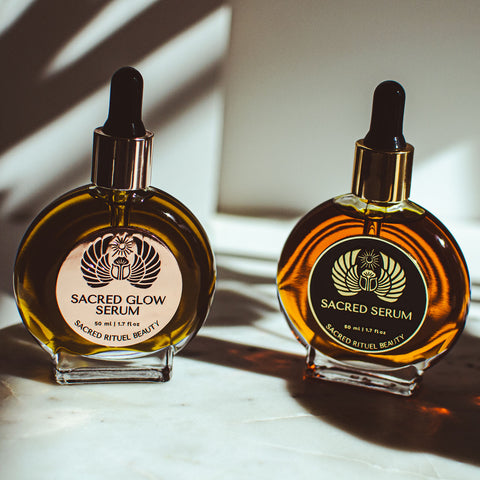
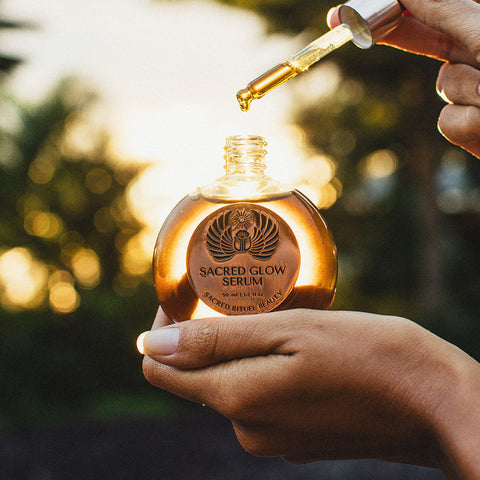
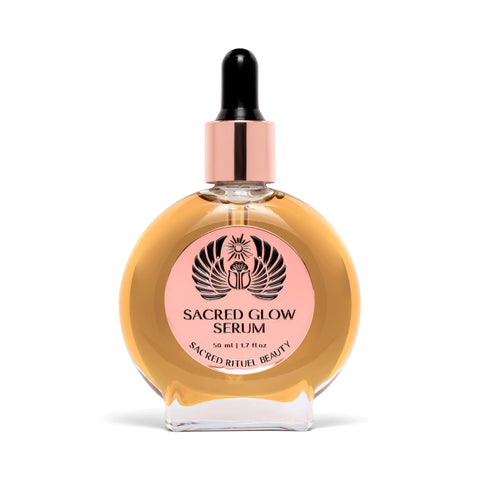
Marysia Miernowska is a folk herbalist, an author, and the founder of the School of the Sacred Wild, and she formulates from a tradition that treats a plant as a complete system rather than a single molecule to be extracted and concentrated. Sacred Serum is a cold-pressed, whole-plant oil: the fatty acids, the antioxidants, the polyphenols, and the vitamin cofactors are kept together rather than stripped apart.
The scientific case for that approach is real. Russo's 2019 review in Frontiers in Plant Science lays out how the effects of a whole-plant extract often come from many compounds working in concert, not one in isolation, and the cold-pressing literature (for example, Szydlowska-Czerniak and Trokowski, 2020, Molecules) documents how avoiding high heat preserves the delicate antioxidants that aggressive processing destroys.
Customers describe softer fine lines, healthy glow, and lasting moisture
Sacred Serum in practice is a single step instead of a shelf of products. Marysia brings the regenerative herbalist philosophy; Sacred Rituel sources from certified organic and regenerative farms and produces, bottles, and batch-numbers every order in Los Angeles.
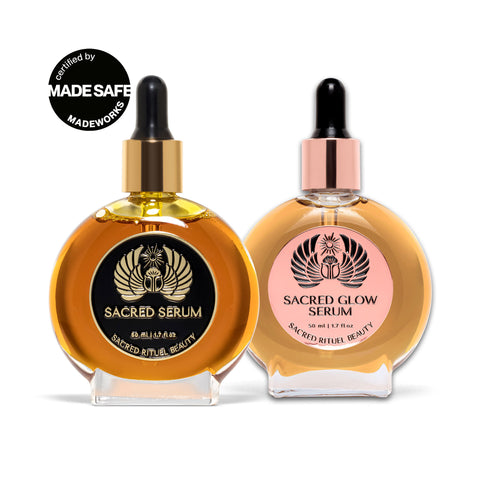
Sacred Serum is USDA Organic, MADE SAFE certified, and Leaping Bunny certified, which is the precondition for skin that has grown reactive, not the headline. The headline is what customers told us happened.
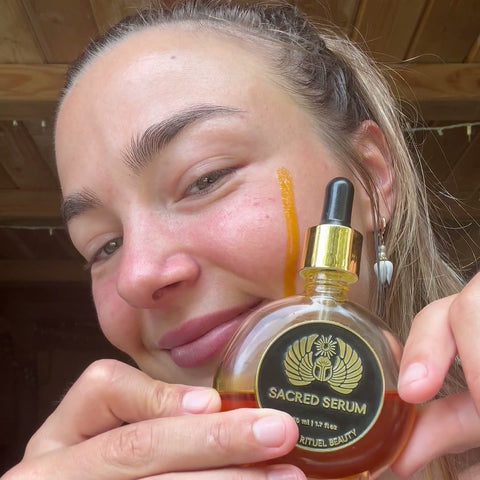
In verified customer reviews tagged to fine lines, the outcome described most often was fine lines looking softer ("many of my fine lines are not nearly as visible, and I have had no irritation whatsoever"), followed closely by a healthy glow ("my skin is glowing like it has never glowed before") and lasting moisture, then a plumper, more supple feel. One customer, at 42, put it plainly: "the glow and plump it gives. I'm 42 and my skin feels 25 years younger. No joke."
Start with one pump of Sacred Serum and a realistic timeline
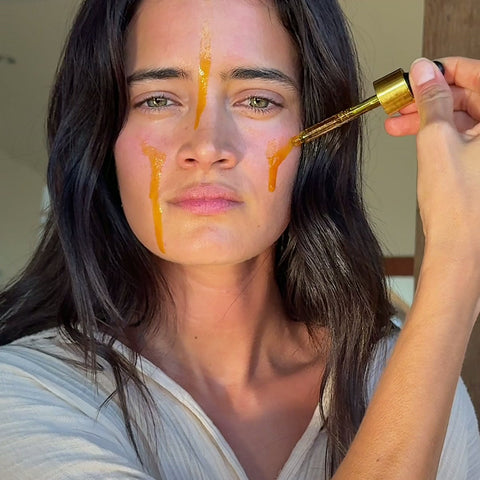
The ritual is simple because your skin is already doing the complicated work. One pump of Sacred Serum, pressed into clean, slightly damp skin in the morning. That is the routine.
Be honest with yourself about the timeline. Comfort and suppleness tend to arrive first, often within the first couple of weeks as Sacred Serum supports the moisture barrier. Changes in tone and texture build more slowly, over a month or two of consistent use.
If your skin is genuinely inflamed or changing rapidly, a clinician belongs in that conversation, because a beautiful ritual supports your skin, it does not replace medical care.
Thirty days in with Sacred Serum, the customers in these reviews were not fighting their age. They were walking out the door bare-faced again, and recognizing the person looking back.


Frequently Asked Questions
Why did my anti-aging skincare routine suddenly stop working in my 40s?
Because around perimenopause, the skin's whole support system shifts at once. Estrogen begins to fluctuate, and the same hormone is involved in collagen signaling, in how well skin holds water, and in barrier resilience. Products designed for younger skin were not designed for skin in this transition, so the active they used to deliver on (a retinol, a brightener, an exfoliating acid) often tips a less-tolerant barrier into reactivity instead. Many in our community describe this exact shift in our reviews. One wrote: "so many products failed me in the past." The path that worked for her was simpler, not stronger.
How long until I see results from a Sacred Rituel routine for mature skin?
Most customers in our reviews notice the first visible change between one and three weeks: softer skin, more even tone, and less of the tight or flaky feeling that comes from a depleted barrier. Deeper changes (line softening, more bounce, more even pigmentation) tend to settle in around four to eight weeks of daily use. This timing matches what the skin needs to fully turn over and rebuild its lipid reserves. One verified Okendo reviewer at 42 described the early-stage shift: "I bought the travel size set to see and I am in love. The day oil is amazing and the glow and plump it gives."
How do I know if my skin barrier is damaged from too many anti-wrinkle treatments?
A handful of consistent signs show up together: a tight, glassy surface after washing; products you used to tolerate now sting; heavier creams sit on top instead of sinking in; redness flares from minor things (a walk in cool air, a brisker cleanse); and fine lines look deeper than they did a few months ago, especially in the morning. Customers in our reviews describe walking into this state without realizing it was happening. The recovery pattern, in their words: pull the actives back, restore the lipids, and let the barrier rebuild. One reviewer who turned a corner this way wrote: "My discoloration has evened, my lines and pores have shrunk. My tone and skin has firmed."
What actually softens fine lines on mature skin if retinol and acids no longer agree with it?
Fine lines look softer when the skin around them is nourished, supple, and holding water. Cold-pressed plant oils like rosehip, sea buckthorn, and pomegranate seed are highly compatible with the skin's own lipid matrix, which is what makes them effective at supporting the barrier. A 2018 review of plant oils in the International Journal of Molecular Sciences (Lin, Zhong, Santiago) documented this mechanism. Customer reviews describe what it looks like in practice. One verified reviewer wrote: "finer eye wrinkles from past sun exposures have really smoothed out." Another, in her late 50s: "super helpful for aging issues... this has been an amazing find."
Will Sacred Rituel work for perimenopausal or menopausal skin that has suddenly become dry, sensitive, or reactive?
This is exactly the skin state Sacred Rituel was designed for. As estrogen fluctuates, skin loses some of the lipid signaling that keeps it calm, hydrated, and resilient, which is why products that used to work suddenly do not. Cold-pressed botanical oils supply lipids that are highly compatible with the skin's own. A verified Okendo reviewer at 49, perimenopausal, wrote: "My face has transitioned from being combination oily to mostly dry... I wake up with my complexion even, smoothing of fine lines, and an overall luminous quality to my skin." A reviewer navigating menopause added: "My skin is beautiful... I feel more comfortable in my skin."
References
- Lin, T. K., Zhong, L., & Santiago, J. L. (2018). Anti-Inflammatory and Skin Barrier Repair Effects of Topical Application of Some Plant Oils. International Journal of Molecular Sciences, 19(1), 70.
- Fujii, T., Wakaizumi, M., Ikami, T., & Saito, M. (2008). Amla (Emblica officinalis Gaertn.) extract promotes procollagen production and inhibits matrix metalloproteinase-1 in human skin fibroblasts. Journal of Ethnopharmacology, 119(1), 53-57.
- Aslam, M. N., Lansky, E. P., & Varani, J. (2006). Pomegranate as a cosmeceutical source: pomegranate fractions promote proliferation and procollagen synthesis and inhibit matrix metalloproteinase-1 production in human skin cells. Journal of Ethnopharmacology, 103(3), 311-318.
- Zielinska, A., & Nowak, I. (2017). Abundance of active ingredients in sea-buckthorn oil. Lipids in Health and Disease, 16(1), 95.
- Marmol, I., Sanchez-de-Diego, C., Jimenez-Moreno, N., Ancin-Azpilicueta, C., & Rodriguez-Yoldi, M. J. (2017). Therapeutic Applications of Rose Hips from Different Rosa Species. International Journal of Molecular Sciences, 18(6), 1137.
- Russo, E. B. (2019). The Case for the Entourage Effect and Conventional Breeding of Clinical Cannabis: No Strain, No Gain. Frontiers in Plant Science, 9, 1969.
- Szydlowska-Czerniak, A., & Trokowski, K. (2020). The Composition and Antioxidant/Antiradical Activity of Cold-Pressed and Hot-Pressed Rapeseed Oils: A Review. Molecules, 25(22), 5275.
Radiance Is Personal. Let’s Reveal Yours...
All Day Glow Essentials