
Cold Pressed Oil For Skin: Why It Matters And How To Choose
Cold pressed oil is plant oil extracted by mechanical pressing alone, with no heat and no chemical solvents, so the delicate actives the plant made (its fatty acids, tocopherols, polyphenols, and carotenoids) reach your skin intact rather than being cooked or stripped out. For skincare this is not a small detail: it is the difference between a living, whole-plant oil and a refined, hollowed-out one. As folk herbalist Marysia Miernowska, who formulates every Sacred Rituel product, puts it, the goal is to keep the whole plant intact and let its parts work together. That is why our facial hero, Sacred Serum, is built from 14 cold-pressed organic botanical oils, and why people in our community keep telling us their skin looks more radiant and feels softer on it. A quick note of good practice: patch test any new oil on your inner arm first.
Key Takeaways:
- Cold pressing keeps the plant whole: Pressing oil out with mechanical pressure alone, with no heat and no solvents, preserves the delicate fatty acids, tocopherols, polyphenols, and carotenoids that high heat and chemical refining destroy.
- The whole plant outperforms its parts: A cold-pressed, whole-plant oil delivers the full phytocomplex, and the synergy of those constituents working together does more for skin than any one isolated molecule (Russo 2019). It is why natural vitamin E, a full family of tocopherols, is richer than a single synthetic form.
- It is why our facial oil works the way it does: Plant oils are documented to support and repair the skin's moisture barrier and are compatible with the skin's own lipids (Lin et al. 2018). Sacred Serum is a blend of 14 cold-pressed organic botanical oils, and people in our community consistently describe a healthy glow and lasting softness.
If you have ever wondered why some plant oils feel alive on your skin while others feel like nothing at all, the answer usually starts with how the oil was pressed. Cold pressing is the gentlest way to get oil out of a seed or fruit, and for skincare it matters enormously. This guide explains what cold pressed oil really is, how the process protects the plant's actives, why a cold-pressed whole-plant oil outperforms a refined one, and how to choose and use a cold-pressed facial oil so your skin looks its most radiant.
At Sacred Rituel, every product is formulated by folk herbalist Marysia Miernowska, founder of the School of the Sacred Wild, from cold-pressed, whole-plant botanicals chosen for what plants actually do for skin. Our facial hero is Sacred Serum, a blend of 14 cold-pressed organic botanical oils built for the delicate skin of the face.
What Is Cold Pressed Oil?
Cold pressed oil is oil extracted from seeds, nuts, or fruits using mechanical pressure alone, without heat and without chemical solvents. The seeds are slowly squeezed in a press, and the temperature is kept low on purpose, because heat is exactly what degrades the most valuable parts of the oil. What you are left with is a pure, unrefined oil that still carries the plant's natural color, aroma, and full nutrient profile.
That nutrient profile is the whole point. Cold pressing preserves the delicate fatty acids, vitamins, antioxidants, tocopherols, polyphenols, and carotenoids the plant produced, the very compounds that high-heat and solvent extraction strip away or break down. A cold-pressed oil is, in a real sense, the living plant captured in a bottle. The alternatives trade that vitality for shelf stability and yield.
How Does Cold Pressed Oil Work?
During cold pressing, the seeds or nuts are placed in a press and squeezed under carefully controlled pressure so the oil flows out without the friction generating much heat. Keeping the temperature low is what protects the oil's beneficial compounds, so the finished oil is rich in the actives the plant made rather than a stripped-down version of them.
Contrast that with how most commercial oils are made. Refined oils are processed with high heat to raise their smoke point and extend shelf life, which strips out much of the natural nutrient content. Solvent extraction uses chemicals such as hexane to pull oil from the seed at scale, which can leave chemical traces behind and, again, sacrifices the delicate actives. Cold pressing gives up some yield and some shelf life in exchange for keeping the plant whole, and for skincare that trade is well worth making.

Why Cold-Pressed, Whole-Plant Oils Outperform Refined And Isolated Ones
The case for cold pressing is not sentimental, it is biochemical. When you keep the whole plant intact and at low temperature, you keep the constituents that actually feed and protect skin, and you keep them working together.
The Whole Plant Beats The Isolated Molecule
Plants are not made of single active ingredients. They are complex matrices of fatty acids, vitamins, and aromatic compounds that act in concert, an effect researchers call the entourage effect: the full phytocomplex does more than any one molecule pulled out of it (Russo 2019). This is the herbalist's oldest principle, now well documented. A cold-pressed whole-plant oil delivers that synergy. A refined or fractionated oil delivers a hollowed-out version of it.
Natural Vitamins Come With Their Cofactors
Cold-pressed plant oils are naturally rich in vitamin E, and natural vitamin E is not one molecule but a whole family of tocopherols and tocotrienols, a far richer antioxidant package than the single synthetic form added to many products. The same logic holds for vitamin C: in a whole-food plant matrix it arrives with the cofactors that make it more bioavailable than an isolated synthetic version (Carr & Maggini 2017). Whole-plant rosehip, for instance, is a natural source of vitamin C and carotenoids, and rosehip seed oil is clinically shown to improve the look of redness and discoloration. Cold pressing is what keeps those fragile vitamins alive in the oil.
Plant Oils Are Compatible With Your Skin
Beyond the actives, the structure of cold-pressed plant lipids matters. Plant oils are documented to support and repair the skin's moisture barrier, and because their fatty acids share the structure of the skin's own lipids, they are compatible with its natural lipid matrix and absorb to condition the deeper layers of the outer skin (Lin et al. 2018). That is why a well-made facial oil sinks in and leaves skin soft rather than sitting on top of it.
Cold-Pressed Oils For Your Skin
Many plant oils can be cold-pressed, and each brings its own gifts to skin. These are some of the cold-pressed botanicals most loved in skincare, several of which live in our own formulas:
- Jojoba Oil: A lightweight oil whose wax esters closely mimic the skin's own sebum, which makes it a friend to nearly every skin type. It absorbs quickly without a greasy residue and is prized for its balancing, nourishing nature.
- Rosehip Oil: Rich in essential fatty acids and a natural source of vitamin C and carotenoids, rosehip is beloved for supporting the look of firmer, smoother, more even-toned skin.
- Apricot Kernel Oil: Gentle and softening, apricot kernel oil is a lovely choice for sensitive or easily-irritated skin, leaving it nourished and supple.
- Sea Buckthorn: Exceptionally high in carotenoids and fatty acids, sea buckthorn is a vivid source of antioxidants that support a radiant, even-looking complexion.
- Chia Seed Oil: Abundant in omega fatty acids and antioxidants, chia helps skin hold onto moisture and feel comfortable.
You will also see cold pressing used widely in the kitchen, for culinary oils like olive, coconut, avocado, flaxseed, and sunflower, which are prized for the same reason: cold pressing keeps the plant's nutrients intact. For your face, though, the real magic is not in any single oil but in a thoughtfully composed whole-plant blend, where many cold-pressed botanicals work in synergy.
Why is cold pressed oil more expensive?
Cold pressing costs more because it is the slower, gentler, lower-yield way to make an oil, and because it usually goes hand in hand with organic, well-sourced botanicals. You are paying for a labor-intensive process that protects the plant's actives instead of maximizing output, and that protection is exactly what makes a cold-pressed oil worth it for skin.
A Nutrient-Rich, Living Oil
Because no heat or solvent strips them out, cold-pressed oils keep their natural vitamins, antioxidants, and essential fatty acids. That gives the oil a genuinely rich nutritional profile, a wholesome blend of plant constituents that nourish and condition skin, rather than the emptied-out feel of a heavily refined oil.
Works In Harmony With Your Skin
Cold-pressed plant oils work with the skin's own oils rather than against them. They help condition the skin, support the moisture barrier, and leave texture looking smoother and more radiant, which is why a quality cold-pressed facial oil can become the cornerstone of a simple routine.
Calming For Sensitive Skin
Many cold-pressed oils, such as jojoba and apricot kernel, are gentle and soothing, which makes them welcome choices for sensitive or easily-irritated skin. People in our community with reactive skin often tell us a whole-plant oil is one of the few things their skin stays calm with.
Aromatherapeutic By Nature
The natural aroma of a cold-pressed botanical comes from the plant itself, never from synthetic fragrance. That subtle, plant-true scent is part of why anointing your skin with oil feels like a grounding ritual rather than just a step.

Can cold pressed oils be heated?
The whole value of a cold-pressed oil is that it never met high heat, so subjecting it to high temperatures undoes the point: heat degrades the delicate fatty acids, vitamins, and antioxidants that cold pressing worked to preserve. For culinary oils that means using them gently, and for skincare it means how you store and handle the oil matters, because the same actives that heat destroys, light and air can degrade too.
Store It Away From Heat And Light
Keep cold-pressed oils in a cool, dark place with the cap sealed. Delicate plant oils are sensitive to light, which is why the best are bottled in light-shielding glass rather than plastic. Protective storage keeps the antioxidants potent from the first drop to the last.
Choose Genuinely Cold-Pressed, Organic Oils
Look for oils that are truly cold-pressed and, ideally, certified organic. Cold pressing preserves the nutrients and antioxidants; organic growing means the plant lipids reaching your skin are clean and free of synthetic pesticide residues. Avoid products padded with additives, fillers, or synthetic fragrance, which dilute what actually feeds your skin.
A Little Goes A Long Way
Cold-pressed oils are concentrated, so a few drops are plenty. Warm the oil between your palms and press it into slightly damp skin for the best absorption, and you will get deep nourishment with no greasy heaviness.
To go deeper on what to look for and what to leave on the shelf, see our guides to what to avoid in skincare and the best minimalist skincare brands.
Is cold pressed oil good for your face?
Yes. A cold-pressed, whole-plant facial oil is one of the most nourishing things you can give facial skin, because it brings the fatty acids, antioxidants, and plant lipids the skin loves in a form it can actually use. This is exactly why we built Sacred Serum around cold-pressed oils.
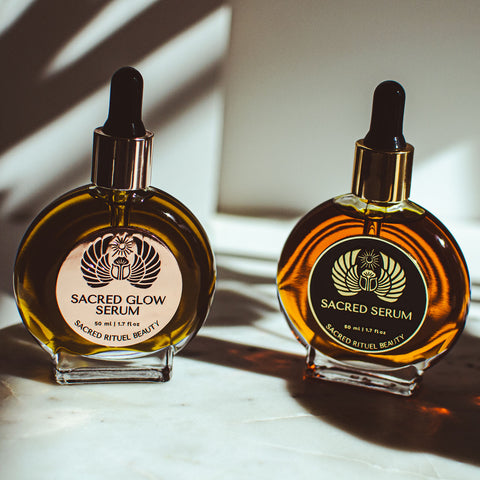
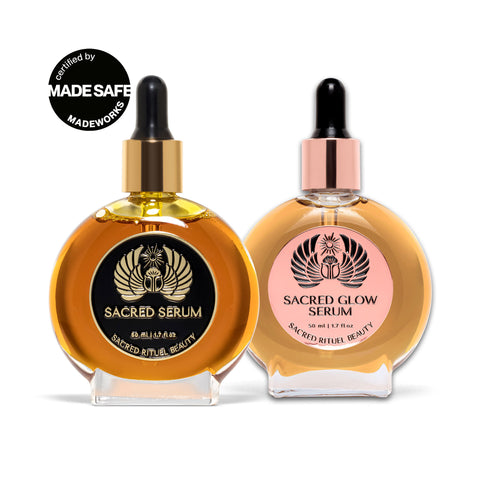
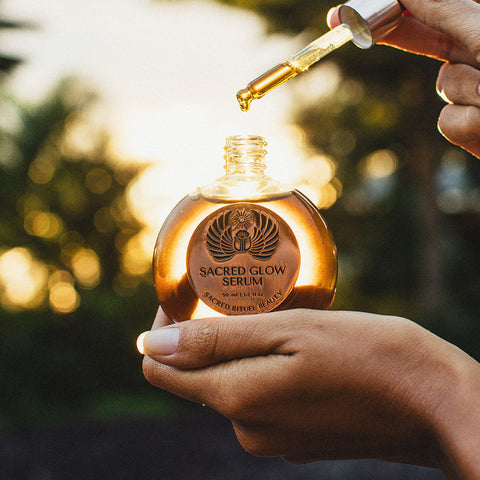
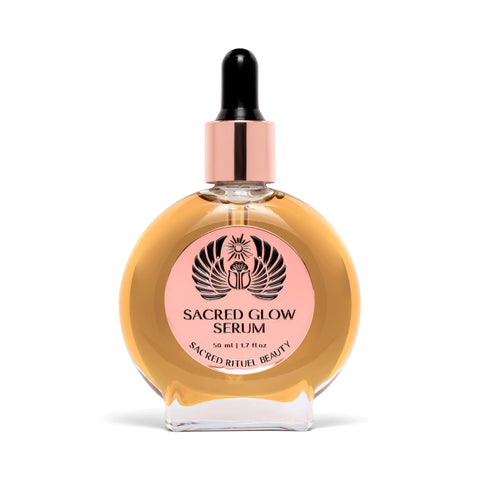
Sacred Serum is a blend of 14 cold-pressed organic botanical oils, including jojoba, rosehip, and apricot kernel, composed so the whole-plant phytocomplex works in synergy on the delicate skin of the face. Because the oils are cold-pressed, the antioxidants and fatty acids stay intact; because they are whole-plant and lipid-compatible, they absorb to condition skin and support the moisture barrier rather than sitting on top of it. And it is fragrance-free, with only the plants' own natural aroma.
People in our community describe the difference plainly. Many tell us about a healthy glow, one writing that "everyone stops me to say wow you're glowing." Many describe lasting moisture and skin that feels soft, one saying the serum "makes your skin feel like silk," and people consistently note that it absorbs cleanly "without leaving a greasy residue." Others mention a more even-looking tone over time. These are the outcomes a living, cold-pressed oil is built to support.
How To Use A Cold-Pressed Facial Oil
Press three to five drops of Sacred Serum into clean, slightly damp skin morning and night, after cleansing and any mist. Damp skin gives the oil water to seal in, and a gentle press rather than a rub helps it absorb. If you want the full ritual for face and body together, the Sacred routine set pairs the serum with a rose mist and our body oil so the whole practice lives together. A cold-pressed facial oil is a nourishing layer of care, not sun protection, so keep wearing a dedicated SPF in the day.
What are the disadvantages of cold pressed oil?
Cold pressing has trade-offs worth knowing, and none of them are reasons to avoid a well-made whole-plant oil, just reasons to choose and store it thoughtfully.
- Shorter shelf life: Because the natural antioxidants are intact and there are no synthetic preservatives, cold-pressed oils are best used within their window and kept cool and dark. That freshness is a feature, not a flaw.
- Higher cost: The gentle, low-yield process and organic sourcing cost more than industrial refining, as covered above.
- Quality varies widely: Not all oils labeled cold-pressed are equal. Source, freshness, and whether the oil is truly whole-plant all change the result, so buy from brands that are transparent about how their oils are made.
- Find the right oil for your skin: Different botanicals suit different skin. A whole-plant blend is composed to work across skin types, but it is always good practice to patch test a new oil on your inner arm first.
For more on building a gentle, effective ritual around whole-plant oils, see our guide to DIY face masks for glowing skin.
Final Thoughts On Cold Pressed Oil
Cold pressed oil is not just a marketing word on a label, it is a promise about what survives the journey from plant to bottle. By pressing oil out with nothing but gentle pressure, cold pressing keeps the fatty acids, tocopherols, polyphenols, and carotenoids the plant made, and keeps them working together the way the plant intended. That is the difference between an oil that feels alive on your skin and one that does not.
It is also the principle every Sacred Rituel formula is built on. Sacred Serum brings 14 cold-pressed organic botanical oils into one whole-plant blend for the face, and the radiant, softer, more comfortable skin people in our community describe is what happens when you give skin the living plant rather than a refined echo of it. Trust the wisdom of the plants, and let your daily anointing become a sacred ritual for your skin.
Sources:
- Russo, E. B. (2019). The Case for the Entourage Effect and Conventional Breeding of Clinical Cannabis: No "Strain," No Gain. Frontiers in Plant Science, 9, 1969. https://doi.org/10.3389/fpls.2018.01969
- Lin, T.-K., Zhong, L., & Santiago, J. (2018). Anti-Inflammatory and Skin Barrier Repair Effects of Topical Application of Some Plant Oils. International Journal of Molecular Sciences, 19(1), 70. https://doi.org/10.3390/ijms19010070
- Carr, A. C., & Maggini, S. (2017). Vitamin C and Immune Function. Nutrients, 9(11), 1211. https://doi.org/10.3390/nu9111211
- Chandra, S., Kumar, M., Dwivedi, P., & Shinde, L. P. (2020). Functional and nutritional health benefits of cold-pressed oils: a review. Journal of Agriculture and Ecology, 9, 21-29. https://journals.saaer.org.in/index.php/jae/article/view/275
Frequently Asked Questions
Why is cold pressed oil more expensive?
Cold pressing costs more because it is slower, gentler, and lower-yield than industrial refining, and it usually goes with organic, well-sourced botanicals. The process protects the plant's delicate actives instead of maximizing output, which is exactly what makes a cold-pressed oil worth it for skin. You are paying for a living, nutrient-rich oil rather than a refined, hollowed-out one.
Can cold pressed oils be heated?
It is best not to. The whole value of a cold-pressed oil is that it never met high heat, and high temperatures degrade the delicate fatty acids, vitamins, and antioxidants that cold pressing preserved. Culinary cold-pressed oils should be used gently, and skincare oils should be kept cool and dark in light-shielding glass, since heat, light, and air all break down the actives over time.
What are the popular types of cold pressed oils available?
For skin, beloved cold-pressed botanicals include jojoba, rosehip, apricot kernel, sea buckthorn, and chia seed oil, each bringing its own fatty acids and antioxidants. In the kitchen you will see cold-pressed olive, coconut, avocado, flaxseed, and sunflower oils. The real magic for your face, though, is a whole-plant blend, where many cold-pressed oils work in synergy, as in our Sacred Serum.
How to store cold pressed oil?
Keep cold-pressed oils in a cool, dark place with the cap sealed. Because their natural antioxidants are intact and there are no synthetic preservatives, they are sensitive to heat, light, and air. Light-shielding glass rather than plastic is best, and storing the oil away from sunlight and strong odors keeps it fresh and potent from the first drop to the last.
Are cold-pressed oils suitable for all skin types?
Cold-pressed oils suit most skin types, and a thoughtfully composed whole-plant blend is designed to work across them. Lightweight, sebum-like oils such as jojoba are friendly to nearly every skin type, including oily and combination skin, since they absorb without a greasy residue. Individual skin varies, so it is always good practice to patch test a new oil on your inner arm first.
Can I use cold-pressed oils on my hair, and if so, which types are best for hair care?
Yes, many cold-pressed oils are lovely for hair. Jojoba and argan oils are popular for smoothing and conditioning, and a few drops worked through the ends can soften and add shine. Use them sparingly so hair does not feel weighed down. For your face, reach for a dedicated whole-plant facial oil like Sacred Serum rather than a general carrier oil.
Is cold pressed oil good for your face?
Yes. A cold-pressed, whole-plant facial oil is one of the most nourishing things you can give facial skin, because it brings the fatty acids, antioxidants, and plant lipids skin loves in a form it can use. Plant oils are documented to support the moisture barrier and are compatible with the skin's own lipids. Our Sacred Serum is a blend of 14 cold-pressed organic botanical oils, and people in our community consistently describe a healthy glow and softer, more comfortable skin.
What are the disadvantages of cold pressed oil?
Cold-pressed oils have a shorter shelf life because their natural antioxidants are intact and there are no synthetic preservatives, so they are best kept cool and dark and used within their window. They also cost more, since the gentle, low-yield process and organic sourcing are more expensive than industrial refining. Quality varies between brands too, so choose oils that are transparent about how they are made. None of these are reasons to avoid a well-made whole-plant oil, just reasons to choose and store it well.
Radiance Is Personal. Let’s Reveal Yours...


All Day Glow Essentials