
Organic vs. Natural
The difference between natural and organic skincare comes down to one word: regulation. "Organic" is a certified, legally defined standard, governing how an ingredient is grown and processed, with no synthetic pesticides, herbicides, or GMOs, and verified by bodies like the USDA and COSMOS. "Natural" has no regulated definition at all, so a product can carry the word while still containing synthetics, fillers, or heat-stripped oils. The distinction matters because it changes what actually reaches your skin: nutrients carried in a whole-food plant matrix, complete with their natural cofactors, are more bioavailable than isolated synthetic forms (Carr & Maggini 2017), and cold-pressing keeps those delicate actives alive where heat and solvents would destroy them. This is the standard folk herbalist Marysia Miernowska, founder of the School of the Sacred Wild, formulates every Sacred Rituel product to: certified organic, cold-pressed, and fragrance-free. Our face hero, Sacred Serum, is the embodiment of it, and in our reviews people consistently tell us their skin looks radiant and feels deeply nourished. A quick note of good practice: patch test any new oil on your inner arm first.
Key Takeaways:
- Organic is regulated, natural is not: "Organic" is a certified legal standard for how an ingredient is grown and processed, while "natural" has no regulated definition and can be used freely, even on products that still contain synthetics.
- Processing decides potency: Cold-pressing preserves the delicate tocopherols, polyphenols, and carotenoids that heat and solvents destroy, and nutrients in a whole-food plant matrix are more bioavailable than isolated synthetic forms (Carr & Maggini 2017).
- Look past the buzzwords: Trust certified organic seals, recognizable cold-pressed botanicals, and full transparency over vague terms like "natural," "clean," or "green."
Walking through skincare today can feel like stepping into a garden of promises. So many products claim to be "clean," "natural," or "organic," but only some of those words actually mean something. The honest, confident answer is that one of these terms is a regulated standard and the other is not, and knowing the difference changes what you choose to put on your skin.
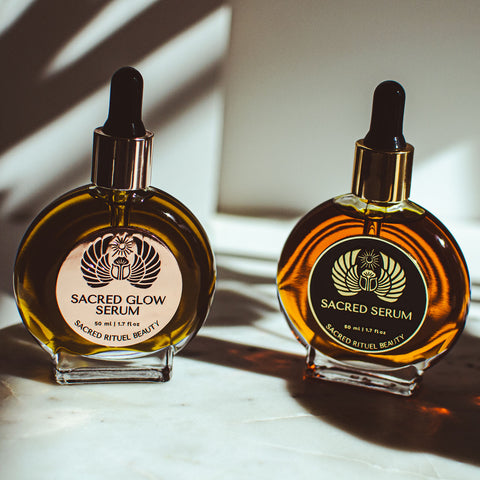
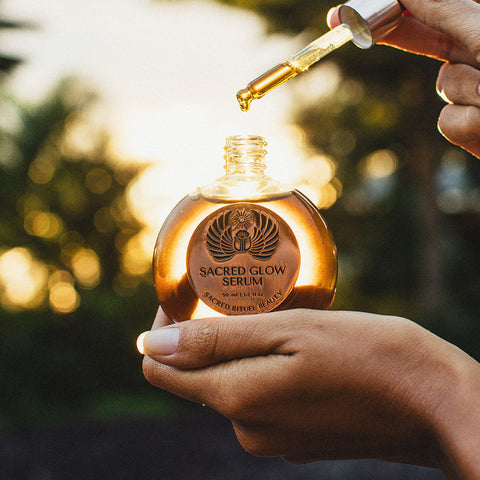
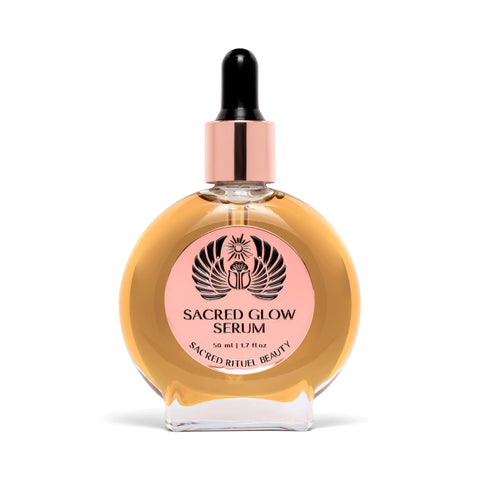
At Sacred Rituel, every product is formulated by folk herbalist Marysia Miernowska, founder of the School of the Sacred Wild, from cold-pressed, certified-organic, whole-plant botanicals chosen for what plants genuinely do for skin. Our face hero is Sacred Serum, a cold-pressed phytocomplex of fourteen organic botanical oils built to nourish the skin's barrier with whole-plant compounds rather than isolated synthetic actives. In this guide we will define both terms with conviction, show you why the distinction matters for your skin, and give you a simple way to read past the marketing on any label.
What Does "Natural" Really Mean In Skincare?
"Natural" sounds reassuring, like something fresh from the earth and untouched. The honest truth is that the term has no regulated standard in the beauty industry. There is no legal definition of what qualifies as "natural," which means a product can carry the word while still containing synthetics, preservatives, or heavily processed ingredients that have lost much of their original benefit.
Brands reach for the word to imply gentleness and simplicity, but unless a product is transparent about how its ingredients are sourced and processed, "natural" is more of a marketing word than a meaningful promise. A "natural" oil might genuinely come from a plant, yet if it has been heat-extracted or cut with fillers, it loses much of its nutrient power before it ever touches your skin. This is exactly why processing matters as much as origin, and why we cold-press: cold-pressing extracts oil without heat or solvents, preserving the delicate tocopherols, polyphenols, and carotenoids that high heat would destroy.
So the takeaway is simple. "Natural" on its own tells you almost nothing reliable. You have to look at how the ingredients were grown, pressed, and preserved, and whether the brand is willing to show you.
What Does "Organic" Mean In Skincare?
"Organic" is not a vibe or a trend. It is a regulated promise. Certified organic ingredients must be grown without synthetic pesticides, herbicides, or genetically modified organisms, and they must be handled using methods that preserve their natural nutrients and antioxidants. Organic is about both where an ingredient comes from and how it is treated from seed to bottle, and that combination is what sets it apart from the loose language of "natural."
Unlike "natural," organic carries real weight because it is verified. Independent bodies such as the USDA and COSMOS certify against strict, published standards, so a certified organic seal is an outside party confirming the claim rather than the brand simply asserting it. A cold-pressed, certified-organic oil like rosehip, jojoba, or pomegranate retains far more of its skin-loving nutrients than a conventional, heat-refined version of the same plant.
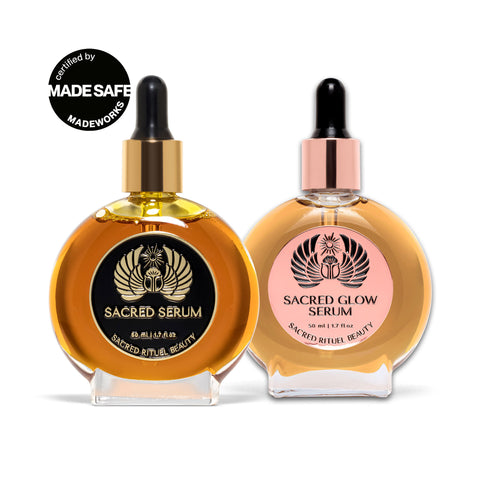
At Sacred Rituel, our oils are certified organic and cold-pressed, chosen for their therapeutic potency and formulated with integrity from start to finish. Sacred Serum is USDA Organic, MADE SAFE, and Leaping Bunny certified, and it is fragrance-free of any synthetic scent, which together take the guesswork out of the label.
Can a product be both natural and organic?
Yes, and the best ones are both, but only when the natural ingredients are also certified organic. The two words describe different things: "natural" points to where an ingredient comes from, while "organic" describes how it was grown and processed and is backed by certification. A natural product is not automatically organic, but a certified organic product made from plants is, by definition, both. The real difference between the two lives in regulation, transparency, and processing.
- Natural ingredients may be derived from plants, minerals, or animals, but they are not always pure. They can be chemically processed or blended with synthetic preservatives, and no universal definition or certification is required to use the word at all.
- Organic is a legal standard. Certified organic ingredients must be grown and handled without synthetic pesticides or GMOs and processed using methods, like cold-pressing, that retain their natural benefits. The certification is the safeguard that the word "natural" lacks.
There is also a quiet reason organic tends to be more potent, and it is rooted in the science. Nutrients delivered the way the plant grew them are often more usable by the body: vitamin C carried in a whole-food matrix with its natural cofactors is more bioavailable than an isolated synthetic form (Carr & Maggini 2017), and natural vitamin E arrives as the full family of tocopherols rather than a single synthetic isomer. Herbalists have long understood what research now calls the entourage effect, that the many compounds in a whole plant work in concert and do more together than any one of them isolated (Russo 2019). Choosing certified organic, whole-plant skincare is how you give your skin that full, intact gift.
Why It Matters: Purity, Safety, And Sourcing
Choosing between organic and natural is about more than a label. It is about what your skin absorbs and how the earth is treated in the process. Here is why the difference truly matters.
Purity Affects Performance
The purer the ingredient, the more potent the benefit. A cold-pressed, certified-organic oil keeps its antioxidants, vitamins, and essential fatty acids intact, and those are the compounds that condition skin and reinforce its barrier. Plant oils are documented to support and repair the skin's moisture barrier, and because they share the structure of the skin's own lipids, they are compatible with its natural lipid matrix and sink in to nourish rather than sitting on top (Lin et al. 2018). A heavily processed "natural" oil, by contrast, can lose much of that nutrient value before it reaches your skin.
Safety Is A Long-Term Investment
Not every concern shows up as an instant reaction. Certified organic skincare avoids the synthetic preservatives, parabens, and added synthetic fragrance that are common in unregulated "natural" formulas, and added synthetic fragrance in particular is one of the most common causes of skin irritation. That matters most for the products you leave on your skin every day, like a daily facial oil. Sacred Serum is fragrance-free and MADE SAFE certified for exactly this reason.
Sourcing Impacts The Planet And Your Skin
Organic farming avoids synthetic pesticides, GMOs, and chemical fertilizers, which protects soil health, water systems, and biodiversity. Choosing organic supports farmers committed to sustainability and transparency, and it means the plant lipids reaching your skin are clean and free of residues. It is a choice that is kinder to your skin and to the land at once.
What To Look For On Labels
Labels can be confusing, especially when "natural," "clean," and "green" are used freely with little regulation behind them. But a few simple checks let you choose with confidence.
Look For Certified Organic Seals
A certified organic seal means an independent body has verified the product against strict standards for farming and production. Seals like USDA Organic confirm a high proportion of organic ingredients and the absence of harmful chemicals. When you see one on a face oil or moisturizer, it is a sign of both safety and quality that the word "natural" can never give you on its own.
Read The Ingredient List Carefully
Ingredients are listed from highest to lowest concentration, so if water or a synthetic filler tops the list, the formula may not be as pure as it claims. Favor recognizable plant-based names, like rosehip oil, jojoba, or calendula, especially when marked organic or cold-pressed. A whole-plant facial oil with a short, legible ingredient list is often a better sign than a long one full of synthetic single-molecule isolates.
Check For Transparency, Not Just Buzzwords
Some brands use "natural" or "clean" as a marketing hook without ever explaining what those words mean in their products. A trustworthy brand tells you how its ingredients are sourced, pressed, and preserved, not just how pretty the packaging looks. True organic skincare is built on honesty, not hype, and a minimalist, transparent brand with a short, intentional ingredient list is often the most trustworthy of all.
Pay Attention To Processing Methods
How an ingredient is extracted directly affects its potency and purity. Cold-pressed oils retain far more nutrients than those extracted with heat or solvents, which is why a single word on the label can tell you so much. Look for "raw," "cold-pressed," or "unrefined" when choosing a moisturizer or oil, and you will be choosing the living, nutrient-rich version of the plant.
Watch For The Word "Fragrance"
"Fragrance" might sound harmless, but it is often a placeholder for dozens of undisclosed synthetic chemicals, and it is one of the most common irritants in skincare. It is also prohibited under genuine organic certification. Skip products that list "fragrance" or "perfume" with no explanation, and favor formulas that are fragrance-free or draw their aroma only from whole botanicals.
Building A Simple Certified-Organic Routine
You do not need a crowded shelf to give your skin what it needs. A few cold-pressed, certified-organic products, used consistently, do more than a long routine of isolated synthetic actives. Here is a simple, nourishing rhythm.
Cleanse Gently
Start with a gentle oil cleanser that lifts away makeup and the day without stripping your skin. A certified-organic, fragrance-free cleanse leaves your skin feeling clean and comfortable rather than tight, and it sets the stage for everything that follows.
Mist And Nourish
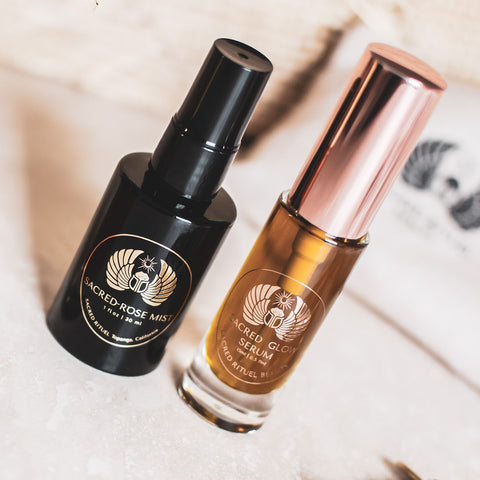
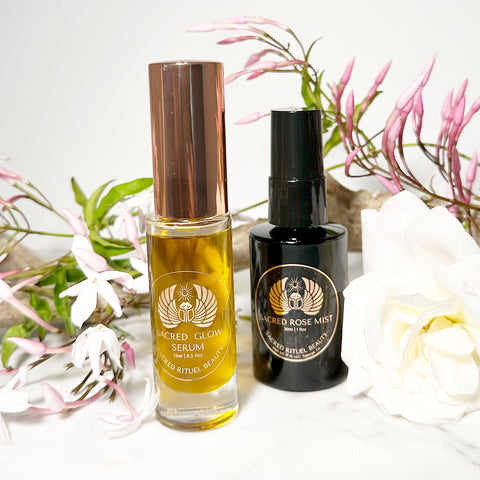
Press a hydrosol mist into damp skin, then massage in a few drops of a whole-plant facial oil while your skin is still dewy, so the oil conditions your skin with plant lipids and helps seal in the moisture on its surface. If you would like your whole ritual together, the Sacred routine set pairs Sacred Serum with a rose mist and our body oil so face and body are cared for in one rhythm. Two ingredient heroes earn their place here: Jojoba Oil, whose wax esters closely resemble the skin's own sebum so it absorbs cleanly, and Rosehip Oil, a natural source of vitamin C and carotenoids clinically shown to improve the look of redness and discoloration.
Keep It Minimal And Consistent
A whole-plant oil is one nourishing step rather than another layer to juggle. When you are reading labels, our guide to ingredients worth avoiding pairs well with this one, our look at how jojoba oil suits both oily and dry skin goes deeper on a single hero, and for an occasional treat a natural face mask is a lovely weekly ritual. The natural vitamin E that helps keep these cold-pressed oils stable comes as the full family of tocotrienols and tocopherols, not a single synthetic form.
Patch-Testing A New Oil
Whenever you add a new oil to your routine, it is good practice to patch test it first. Apply a small amount to your inner arm and leave it for 24 hours. If your skin stays comfortable, you are good to use it on your face. This simple step is worth the wait, especially for sensitive skin, and it lets you enjoy a new certified-organic oil with confidence.
Final Thoughts
The choice between organic and natural is not really a matter of taste. It is a matter of definition. "Organic" is a certified, regulated standard that governs how a plant is grown and processed and is verified by an independent body, while "natural" is unregulated language that anyone can use. That difference decides what actually reaches your skin: whole, intact, cold-pressed nutrients in their natural matrix, or a stripped, isolated, or synthetic version of the same idea.
This is the standard behind every Sacred Rituel product, formulated by herbalist Marysia Miernowska from cold-pressed, certified-organic, fragrance-free botanicals. If you want one place to begin, a few drops of Sacred Serum pressed into clean, damp skin is the whole philosophy in a single step, and our community describes the result simply: radiant, hydrated, glowing.
Sources:
- Carr, A. C., & Maggini, S. (2017). Vitamin C and Immune Function. Nutrients, 9(11), 1211. https://doi.org/10.3390/nu9111211
- Russo, E. B. (2019). The Case for the Entourage Effect and Conventional Breeding of Clinical Cannabis: No “Strain,” No Gain. Frontiers in Plant Science, 9, 1969. https://doi.org/10.3389/fpls.2018.01969
- Lin, T.-K., Zhong, L., & Santiago, J. (2018). Anti-Inflammatory and Skin Barrier Repair Effects of Topical Application of Some Plant Oils. International Journal of Molecular Sciences, 19(1), 70. https://doi.org/10.3390/ijms19010070
- NCCIH. (2024). Natural Doesn’t Necessarily Mean Safer, or Better. NCCIH. https://www.nccih.nih.gov/health/know-science/natural-doesnt-mean-better
Keep exploring: ingredients to avoid in skincare, how jojoba oil suits oily and dry skin, natural face masks for glowing skin.
Frequently Asked Questions
Can a product be both natural and organic?
Yes, and the best ones are both, but only when the natural ingredients are also certified organic. "Natural" points to where an ingredient comes from, while "organic" describes how it was grown and processed and is backed by certification. So a natural product is not automatically organic, but a certified organic product made from plants is, by definition, both. With Sacred Serum, every botanical is certified organic and cold-pressed, so it is genuinely both.
Why do some natural products still cause skin irritation?
Because "natural" is unregulated, a product can carry the word while still containing synthetic preservatives, added fragrance, or heavily processed ingredients that irritate skin. Even genuine botanicals, especially undiluted essential oils, can occasionally provoke a reaction in sensitive skin. That is why formulation quality, certified-organic sourcing, and a fragrance-free formula matter as much as the word on the label. Patch test anything new on your inner arm for 24 hours first.
Are organic skincare products more expensive for a reason?
Often, yes. Certified organic ingredients require ethical farming, careful cold-pressing, and compliance with strict, independently verified standards, all of which cost more than conventional, heat-refined production. What you are paying for is nutrient-rich, residue-free botanicals delivered the way the plant grew them. For many people, the purity and sourcing integrity make the difference worthwhile, especially for a product like a facial oil that you leave on your skin every day.
Is “green” skincare the same as organic skincare?
No. "Green" is a marketing term with no regulated meaning, the same as "natural" and "clean." It may suggest eco-friendly values, but it is no guarantee that the ingredients are organic, cold-pressed, or even free of synthetics. The only reliable signal is third-party certification, such as USDA Organic, backed by full ingredient transparency. Read the certifications and the ingredient list, not the buzzwords on the front.
Does using organic face toner really make a difference?
Yes. A certified-organic toner or hydrosol mist made from whole botanical infusions can soothe, hydrate, and balance the look of skin without the drying alcohols and synthetic fragrance found in many conventional toners. The benefit comes from the quality and integrity of each botanical, so you are giving your skin nutrition rather than just a splash of moisture. Pressed into damp skin before a few drops of facial oil, a clean mist helps the oil seal in that hydration.
Can organic products go bad faster than natural ones?
Sometimes, because certified organic formulas avoid synthetic preservatives. The good news is that a pure, water-free oil does not need them: with no water for bacteria to grow in, a well-made botanical oil is naturally stable, and its own vitamin E helps keep it fresh. Cold-pressed oils are sensitive to light, so the best are bottled in light-shielding glass and kept out of direct sun, which protects the antioxidants from the first drop to the last.
Radiance Is Personal. Let’s Reveal Yours...
All Day Glow Essentials