
What Oils Are Good For Your Face
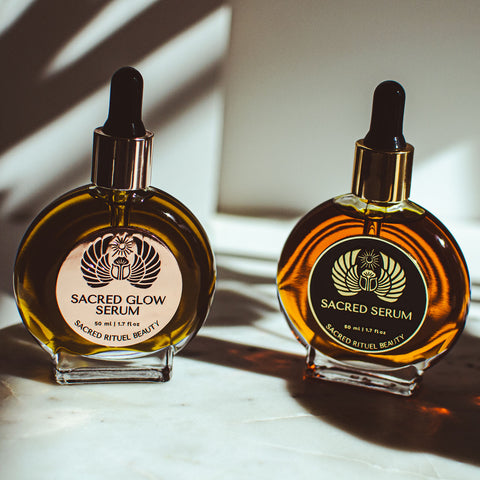
The oils that are good for your face are cold-pressed, unrefined plant oils whose lipids match what your skin already makes: jojoba, rosehip, sea buckthorn, marula, chia, and pomegranate among them. But the deeper truth, the one herbalists have known for centuries, is that no single oil is the answer. A thoughtfully composed whole-plant blend outperforms any one isolated oil, because the full phytocomplex of fatty acids, antioxidants, and plant compounds works in synergy (the entourage effect, Russo 2019), and these lipids are compatible with your skin's own matrix, so they sink in and reinforce the moisture barrier rather than sitting on top (Lin et al. 2018). That is exactly what Sacred Serum is: a cold-pressed blend of 14 organic botanical oils formulated by folk herbalist Marysia Miernowska, and the reason people in our community tell us their skin looks visibly glowing and feels like silk. A quick note of good practice: patch test any new oil on your inner arm first.
Key Takeaways:
- The best face oils are cold-pressed and whole-plant: Unrefined plant oils keep the fatty acids, vitamins, and antioxidants that nourish skin and that heat and solvents destroy. Jojoba balances, rosehip supports the look of even tone, sea buckthorn brightens, marula and chia deeply moisturize.
- A whole-plant blend beats any single oil: The full phytocomplex of many botanicals works in synergy, the entourage effect, and does more together than any one isolated oil could (Russo 2019). Plant oils are also documented to repair the moisture barrier and are compatible with the skin's own lipid matrix (Lin et al. 2018).
- Match the blend to your skin, then let it absorb: Apply a few drops to damp, freshly misted skin as the last step. In our reviews of Sacred Serum, people consistently describe a visible glow and skin that feels like silk, with no greasy residue.
If your face still feels tight, unbalanced, or dull even after a "natural" oil, there is a good chance the oil is not right for you, or that a single oil simply cannot do everything your skin needs. The oils that are good for your face should feel like a nutrient-rich meal for your skin, not a greasy coating. The honest, confident answer to which ones work is this: cold-pressed, whole-plant oils, blended in synergy, are some of the most nourishing things you can give your skin, and the plant world has been doing this work far longer than any lab.
At Sacred Rituel, every product is formulated by folk herbalist Marysia Miernowska, founder of the School of the Sacred Wild, from cold-pressed, whole-plant botanicals chosen for what plants actually do for skin. Our face hero is Sacred Serum, a blend of 14 organic botanical oils built for the delicate skin of the face.
In this guide we will explain what makes an oil genuinely good for your face, walk through the standout botanical oils and what each one offers, show you how to match a blend to your skin type, make the case for why a whole-plant blend beats any single oil, and share how to apply oils so your skin drinks them in.
What Makes An Oil Genuinely Good For Your Face
Whether an oil is good for your face comes down to quality, sourcing, and how it was processed. A truly beneficial face oil absorbs easily, delivers nutrients into the skin, and supports your natural barrier without clogging pores. The oils that benefit facial skin are cold-pressed and unrefined, which means they keep their fatty acids, vitamins, and antioxidants intact. Cold-pressing extracts oil without heat or solvents, preserving the delicate tocopherols, polyphenols, and carotenoids that heat would destroy. Mass-produced, highly refined oils are stripped of these very compounds, leaving little behind.
The best face oils are also chosen for how they meet your skin's own lipids. Plant oils are documented to support and repair the skin's moisture barrier, and because they share the structure of the skin's own fats, they are compatible with its natural lipid matrix and absorb to condition the deeper layers of the outer skin rather than resting on the surface (Lin et al. 2018). The oils that work best mimic what your skin already knows how to use. If you want to go deeper on what to keep away from your face, our guide to pore-clogging ingredients to avoid is a useful companion.

Are all natural oils safe for facial skin?
Not every natural oil belongs on your face, but the right ones are some of the most rewarding skincare you can use. Quality and compatibility with your skin are everything. The oils below have earned their place in clean, whole-plant skincare because they moisturize while offering real botanical benefits, calming the look of irritation, supporting even tone, and balancing how skin feels.
Jojoba Oil
Jojoba Oil is one of the closest matches to your skin's own sebum, which makes it a friend to nearly every skin type. Technically a liquid wax ester rather than a true oil, it shares the structure of the skin's own lipids, so it absorbs cleanly, helps balance how much oil skin produces, and never leaves a heavy residue. Its lightweight nature makes it lovely morning and night. To go deeper, see our piece on how jojoba oil suits both oily and dry skin.
Rosehip Seed Oil
Rosehip Oil is rich in essential fatty acids and a natural source of vitamin C and carotenoids. Rosehip is clinically shown to improve the look of redness and discoloration, which is why it is so loved for supporting a more even, smoother, more resilient-looking complexion over time. It is a quiet powerhouse for tone and texture.
Sea Buckthorn Oil
Sea Buckthorn Oil is a vivid, nutrient-dense oil loaded with omega-7, beta-carotene, and antioxidants. It helps brighten the look of dull, sun-exposed, or reactive skin, and its deep orange hue is a sign of its carotenoid richness. Blended thoughtfully into a whole-plant formula, it lends skin a beautiful golden glow.
Chia Seed Oil
Chia seed oil is abundant in omega-3 fatty acids and antioxidants, and is prized for helping skin hold onto moisture and feel comfortable. Its light, barrier-supportive nature makes it a gentle choice even for skin that breaks out easily.
Pomegranate Seed Oil
Pomegranate seed oil is one of the best oils for skin resilience, especially for mature or dry skin. It is deeply moisturizing and contains punicic acid, a rare omega-5 fatty acid, and it supports a firmer, more conditioned look over time. It earns its place in blends built for skin that wants extra nourishment.
Marula Oil
Marula is rich in monounsaturated fatty acids and antioxidants, making it deeply moisturizing and conditioning while still sinking in without heaviness. It is a wonderful oil for dry, thirsty skin that wants softness without a slick finish.
How To Choose The Right Oil For Your Skin Type
Knowing what your skin needs is the key to choosing oils that are good for your face. Some oils deeply moisturize, others balance how much oil skin makes, and others calm the look of irritation. Here is how to match whole-plant oils to your skin.
Oily Or Congested-Looking Skin
If your skin tends to look oily or congested, reach for lightweight, non-comedogenic oils. Jojoba, chia, and grapeseed help balance how oily skin looks and feels without clogging pores, and they leave no greasy film. People often tell us this is the surprise of using an oil: in our reviews of Sacred Serum, many describe it absorbing right away and, in one person's words, not leaving them "greasy" at all. The most rewarding first step here is a gentle, non-stripping cleanse, so an oil can do its work on clean skin; our gentle oil cleanser respects the barrier rather than stripping it.
Dry Or Dehydrated Skin
Dry skin wants oils rich in barrier-replenishing fatty acids. Marula, pomegranate seed, and sweet almond deliver lasting moisture and a more supple, conditioned look. These oils absorb to condition the deeper layers of the outer skin, softening flakiness and restoring a healthy glow. People consistently tell us their skin stays hydrated and feels nourished long after applying.
Sensitive Or Reactive Skin
If your skin is easily irritated, choose oils that calm and support the barrier. Rosehip, camellia, and calendula-infused oils are gentle yet effective, nourishing without overwhelming. Whole-plant, cold-pressed, organic oils with no synthetic fragrance are the safest bet, since added fragrance is a common cause of irritation. Many people with reactive skin tell us a whole-plant oil is one of the few things that leaves their skin calm rather than reacting.
Combination Skin
For skin that is dry in some areas and oily in others, you want a balancing blend that hydrates without overwhelming. Jojoba's sebum-mimicking nature makes it especially adaptive, which is one reason a well-composed whole-plant blend suits combination skin so gracefully, meeting different zones of the face where they are.

Why A Whole-Plant Blend Beats Any Single Oil
Here is the case for blends, made plainly: no single oil gives your skin everything. Each botanical brings its own gifts, and the real magic is in the synergy of many working together. Herbalists have understood this for centuries, and the science has a name for it: the entourage effect, the principle that the full plant complex outperforms any isolated molecule (Russo 2019). A thoughtful blend layers jojoba's balance, rosehip's tone support, sea buckthorn's brightness, and marula's deep moisture into something greater than the sum of its drops.
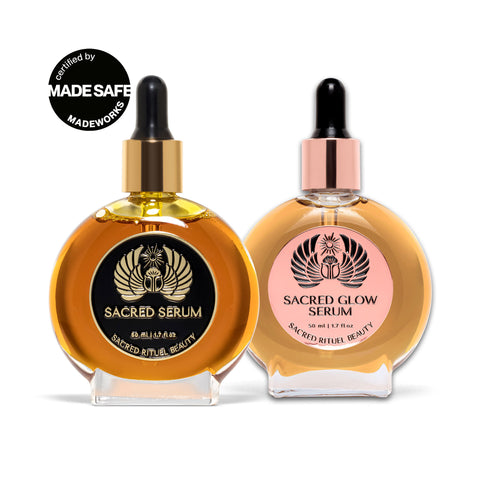
This is exactly how Sacred Serum is built. It is a cold-pressed blend of 14 organic botanical oils, plus herbal infusions, essential oils, and antioxidants like vitamin E, composed so the oils complement one another and deliver lightweight hydration that adapts to all skin types. People in our community describe the result in their own words: a visible glow that draws compliments, with one writing that everyone "stops me to say wow you're glowing," and skin that feels, as another put it, "like silk." Because the formula is whole-plant and cold-pressed, those delicate actives reach your skin intact rather than degraded.
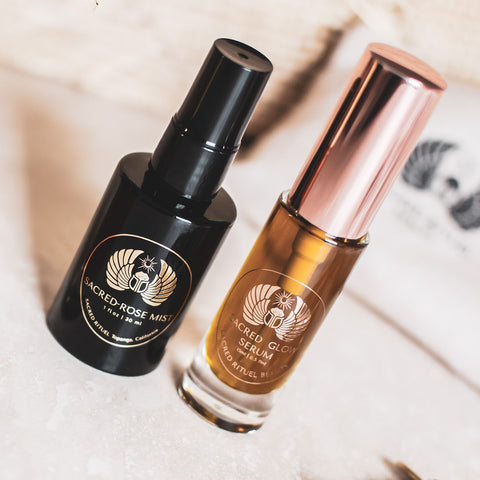
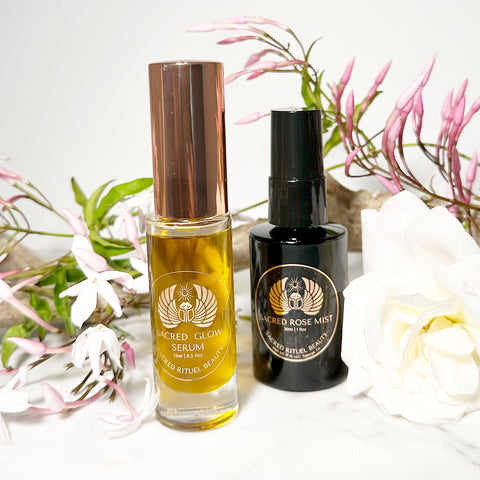
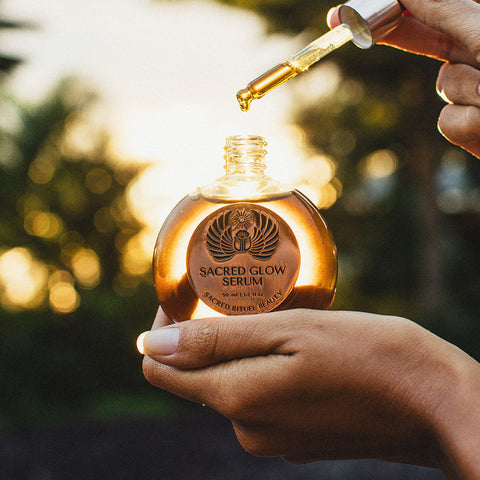
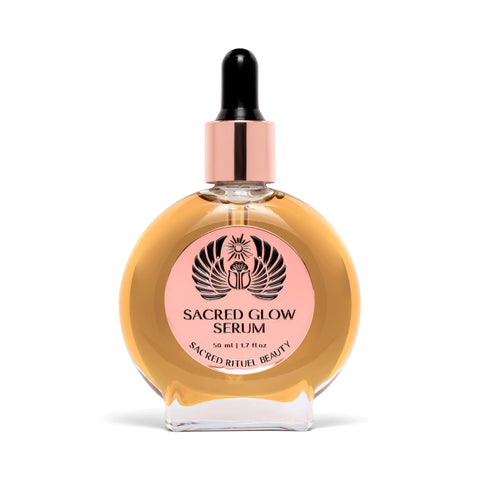
For the face, reach for a dedicated facial blend rather than a body oil, since facial skin is more delicate and has different needs. If you want your whole ritual cared for together, the Sacred routine set pairs Sacred Serum with a rose mist and a body oil. For night, our richer Sacred Glow Serum, built with marula, chia, tamanu, and goji, layers in deeper moisture, while Sacred Serum carries the day. To see how a focused, whole-plant approach compares to crowded shelves, our roundup of the best minimalist skincare brands is worth a read.
Do facial oils replace moisturizer?
Facial oils and moisturizers do slightly different jobs, and a whole-plant oil can do both at once for many people. A traditional moisturizer is mostly water held in with emulsifiers, giving a quick hit of hydration that can evaporate. A facial oil is concentrated, water-free nourishment that conditions the skin with plant lipids and reinforces the barrier that holds moisture in. For many in our community a whole-plant oil becomes the only step their skin needs, while others love to layer it over a water-based product to seal everything in. Either way, oil is best applied with intention, so it absorbs fully. Here is how.
Step 1: Cleanse Gently
Start with clean skin, cleansed without stripping it. Harsh foaming cleansers strip the very lipids and microbiome your barrier depends on; a gentle oil cleanser dissolves makeup and the day while leaving your skin comfortable, not tight. Clean, intact skin is the canvas an oil works best on.
Step 2: Mist So Skin Is Damp
Lightly mist your face with a hydrating toner like our Sacred Rose Mist. A slightly damp surface helps oil absorb more deeply and gives it water to seal in. Never apply oil to a completely dry face; it works beautifully as the step that locks hydration in.
Step 3: Warm And Press In A Few Drops
Place three to five drops of Sacred Serum into your palm, rub your hands together to warm the oil, then press and pat it gently into your face and neck with open palms. Avoid aggressive rubbing, which tugs at the skin. Focus on areas that want extra care, like the cheeks and anywhere that feels dry. A little goes a long way; these blends are concentrated. Used in the morning, a nourishing oil layers beautifully under a real sunscreen; it complements your SPF but never replaces it, since a face oil is not sun protection.

Final Thoughts
The oils that are good for your face are the cold-pressed, whole-plant ones whose lipids match your own, chosen for your skin and, better still, blended in synergy. No single oil does everything; a thoughtful whole-plant blend nurtures, conditions, and reinforces the barrier in ways one isolated oil cannot, and the science of the entourage effect and the moisture-barrier research backs why. When you give your skin that kind of nourishment, you are not just smoothing the surface; you are feeding it what it needs to look and feel its healthiest. That is the philosophy behind every bottle of Sacred Serum, and it is why people in our community keep telling us their skin glows. For more rituals, our DIY face masks for soft, glowing skin are a lovely next step.
Sources:
- Patricia, D., Mihaiela Cornea-Cipcigan, & Mirela Irina Cordea. (2024). Unveiling the mechanisms for the development of rosehip-based dermatological products: an updated review. Frontiers in Pharmacology, 15. https://doi.org/10.3389/fphar.2024.1390419
- Zielińska, A., & Nowak, I. (2017). Abundance of active ingredients in sea-buckthorn oil. Lipids in Health and Disease, 16(1). https://doi.org/10.1186/s12944-017-0469-7
- Lin, T.-K., Zhong, L., & Santiago, J. (2018). Anti-Inflammatory and Skin Barrier Repair Effects of Topical Application of Some Plant Oils. International Journal of Molecular Sciences, 19(1), 70. https://doi.org/10.3390/ijms19010070
- Russo, E. B. (2019). The Case for the Entourage Effect and Conventional Breeding of Clinical Cannabis: No "Strain," No Gain. Frontiers in Plant Science, 9, 1969. https://doi.org/10.3389/fpls.2018.01969
- Gad, H. A., Roberts, A., Hamzi, S. H., Gad, H. A., Touiss, I., Altyar, A. E., Kensara, O. A., & Ashour, M. L. (2021). Jojoba Oil: An Updated Comprehensive Review on Chemistry, Pharmaceutical Uses, and Toxicity. Polymers, 13(11), 1711. https://doi.org/10.3390/polym13111711
Frequently Asked Questions
Are all natural oils safe for facial skin?
Not all natural oils suit facial skin. Some are heavy or comedogenic and can clog pores, and coconut oil in particular is too occlusive for many faces. The oils that are good for your face are cold-pressed, unrefined, and chosen for balance and nourishment, like jojoba, rosehip, sea buckthorn, and marula. Better still, a whole-plant blend such as Sacred Serum composes many of these in synergy so they complement one another. Patch test any new oil on your inner arm first.
Can I mix different oils to create my own blend?
You can, but it takes real knowledge of how each oil behaves, since some are balancing and others richly moisturizing, and an unbalanced mix can overwhelm your skin. There is also a reason a thoughtful formula works so well: the entourage effect means the full phytocomplex of many botanicals does more in synergy than any one isolated oil (Russo 2019). A professionally composed blend like Sacred Serum, formulated by folk herbalist Marysia Miernowska from 14 cold-pressed organic oils, takes the guesswork out and ensures the oils complement each other.
Do facial oils replace moisturizer?
For many people a whole-plant facial oil does the job of a moisturizer and more. A moisturizer is mostly water held in with emulsifiers, while a facial oil is concentrated, water-free nourishment that conditions the skin with plant lipids and reinforces the barrier that holds moisture in (Lin et al. 2018). Many in our community use Sacred Serum as their only step, telling us their skin stays hydrated and feels soft all day, while others love to press it over a water-based product to seal everything in.
Are facial oils suitable for men?
Yes, facial oils benefit everyone's skin. Shaving can leave skin dry and irritated, and a lightweight whole-plant oil soothes that irritation and improves how skin feels and looks. Oils like jojoba also help balance how oily skin appears, which suits skin that runs oily. A blend such as Sacred Serum absorbs cleanly with no greasy residue, which is why so many people fold it into their daily routine.
Can I use body oils on my face?
It is best not to. The skin on your face is more delicate and has different needs, and a body oil's richer blend can feel heavy or clog pores there. For the face, reach for a dedicated whole-plant facial oil like Sacred Serum, formulated for the delicate skin of the face, and keep your body oil for the body where its blend is most at home.
Should I apply facial oils in the morning or at night?
Both. A lightweight whole-plant blend like Sacred Serum is wonderful in the morning, absorbing cleanly under makeup and layering beautifully beneath your sunscreen, which it complements but never replaces. At night, a richer blend such as our Sacred Glow Serum offers deeper nourishment while you sleep. Applying oil morning and night keeps your skin conditioned and comfortable around the clock.
Which oil is the best for your face?
There is no single best oil, because no one oil gives your skin everything. The most effective approach is a whole-plant blend that brings several oils into synergy: jojoba to balance, rosehip for the look of even tone, sea buckthorn for brightness, marula and chia for moisture. This is the thinking behind Sacred Serum, a cold-pressed blend of 14 organic botanical oils. People in our community describe a visible glow, with one writing that everyone "stops me to say wow you're glowing."
What oils not to use on face?
Skip heavy, comedogenic oils that tend to clog pores on the face, most notably coconut oil for many people, along with mineral oil and any highly refined or solvent-extracted oils stripped of their nutrients. Also avoid oils blended with synthetic fragrance, a common cause of irritation. Look instead for cold-pressed, organic, fragrance-free whole-plant oils, and patch test any new oil on your inner arm first. Our guide to pore-clogging ingredients to avoid goes deeper.
Radiance Is Personal. Let’s Reveal Yours...


All Day Glow Essentials